
An airline crew portal is set to accept a login assertion that carries no signature, and a reviewer wants that left in place to reduce login failures during irregular operations. In this deployment, the assertion also arrives without a signed SAML response. What should the trust require instead?
Select an answer to reveal the explanation.
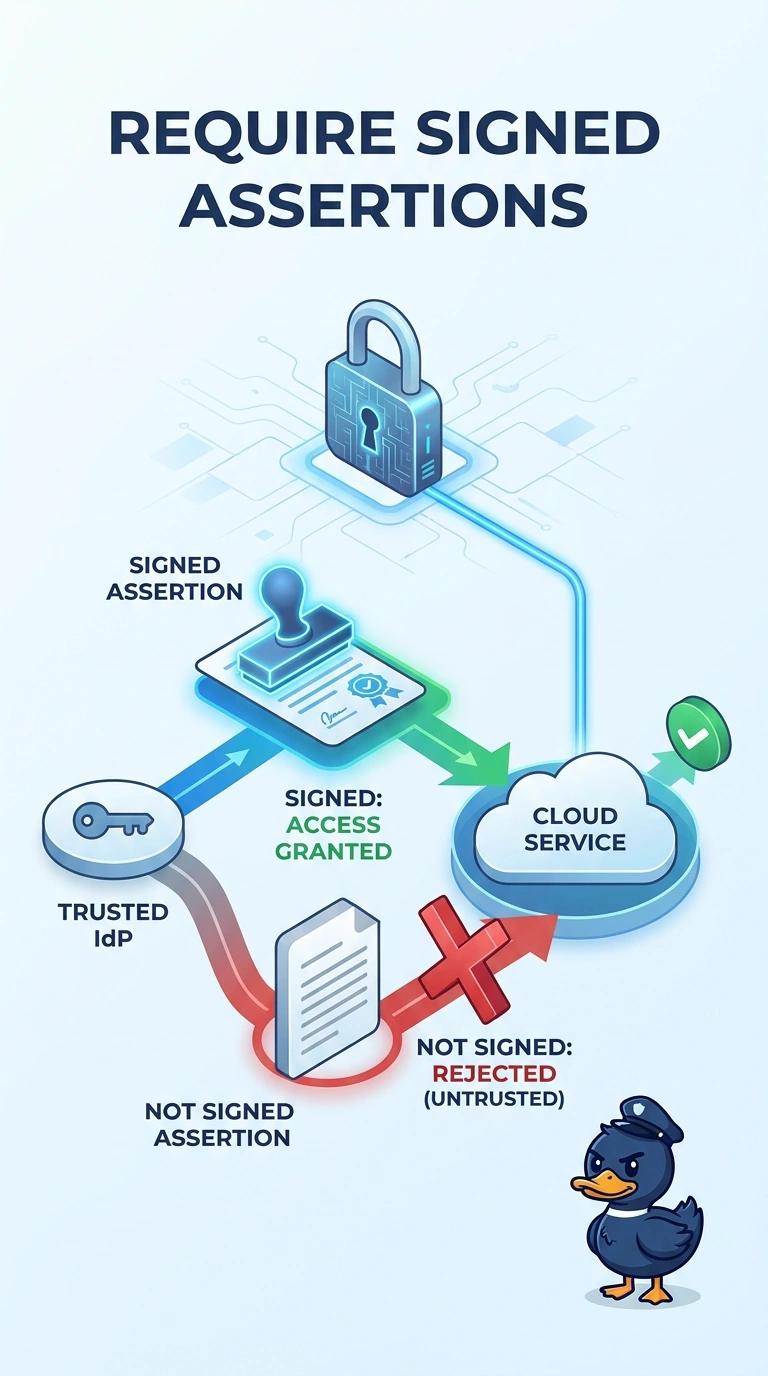
Short Explanation
A paycheck with no signature is just a piece of paper, no matter whose name is printed on it. You require a signed assertion from the trusted identity provider and reject anything that is not signed. Turning the checks off to stop login complaints accepts a document nobody can vouch for.
Full Explanation
The crew portal is the service provider, and it should accept an assertion only when the trusted identity provider signed it. Require and verify the signature on the assertion from the trusted IdP. In this deployment, the assertion also arrives without a signed SAML response. An unsigned assertion can be forged by anyone who can post to the consumer URL, so the trust must require a signed assertion and reject every assertion that is not signed. Accepting any unsigned assertion when the username matches a local directory entry proves only that the attacker typed a real name. It does not prove the identity provider issued the login. Turning off the audience check and the clock check makes validation weaker still and does not supply the missing signature. Putting a shared password in the assertion body replaces a cryptographic signature with a secret that travels inside the message and can be copied. Exam caveat: a signed assertion can still be rejected when the audience, the assertion consumer URL, or the clock does not agree, so requiring a signature does not mean every other check can be ignored. Operational check: submit one unsigned assertion to the crew portal and confirm it is rejected, then sign in through the trusted identity provider and confirm the signed assertion is accepted.