
SAML assertions succeed on every application node in a research lab except one whose clock is far ahead, past the assertion lifetime. What should be corrected on that node?
Select an answer to reveal the explanation.
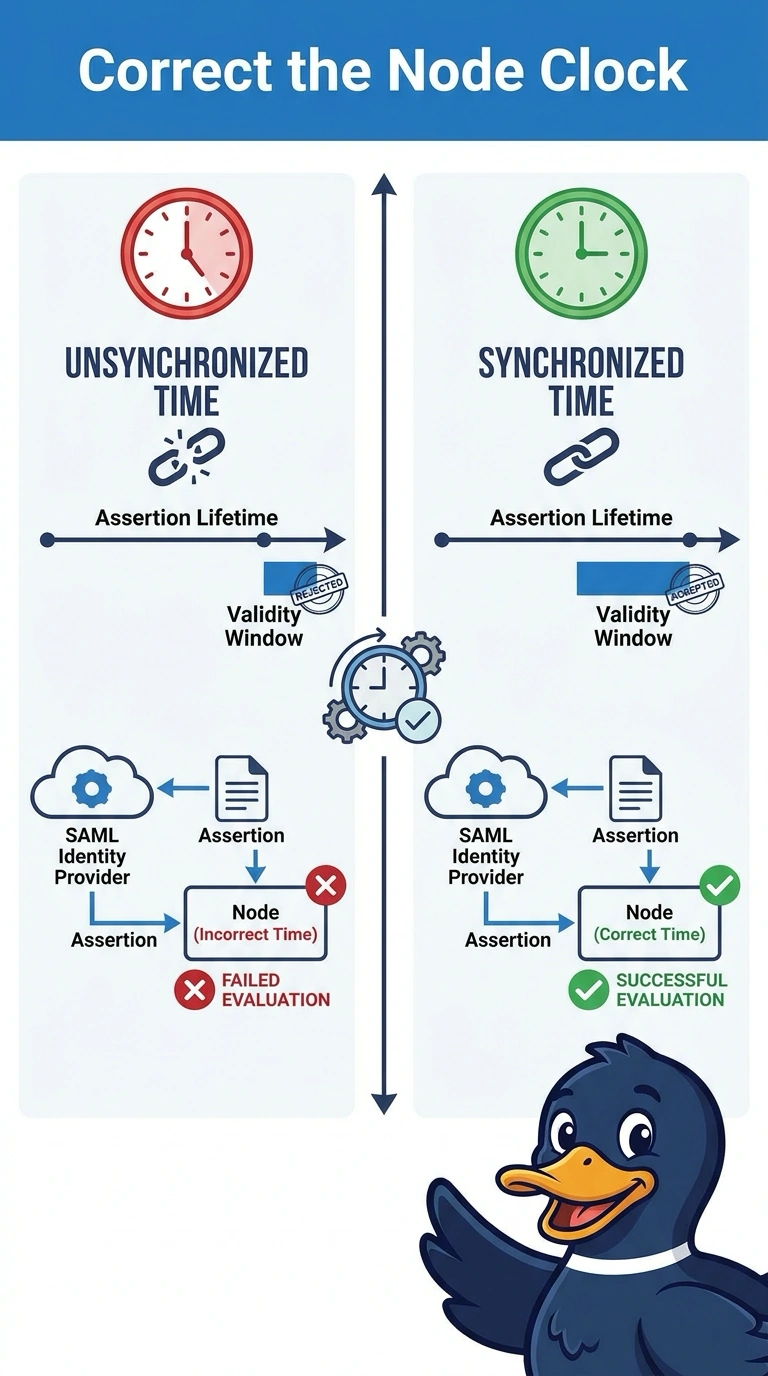
Short Explanation
A punch clock set far ahead throws out a valid time card that every other clock on the floor accepts. You correct time synchronization on the node that is past the assertion lifetime. The trap is changing the audience or resetting passwords when only that one clock is wrong.
Full Explanation
SAML trust includes the clock. An assertion that is still inside its lifetime on every other node fails on the node whose clock is far ahead, so you correct time synchronization on that node so it evaluates the assertion inside the validity window. The audience identifier, which already matches on every lab node where this same assertion is accepted, is not the field that differs. Changing it would risk breaking the nodes that already work. A directory password reset for every lab user, which does not move the clock that is rejecting the assertion, rotates a credential the failure does not mention. SCIM group membership for the lab staff, which does not decide whether the assertion is still inside its lifetime, controls provisioning. It does not accept or reject a signed assertion based on time. Exam caveat: when the failure is isolated to one node and the clock is the thing that is different, fix time on that node before you rebuild trust identifiers that already succeed elsewhere. Operational check: compare the failing node's clock with a node that accepts the same assertion, correct the skew, and sign in again.