
A school district laptop was stolen, yet the endpoint agent still reports disk encryption, current patches, and a managed profile. A lead wants to treat that posture pass as proof of the rightful user. What still has to be checked before access is allowed?
Select an answer to reveal the explanation.
Short Explanation
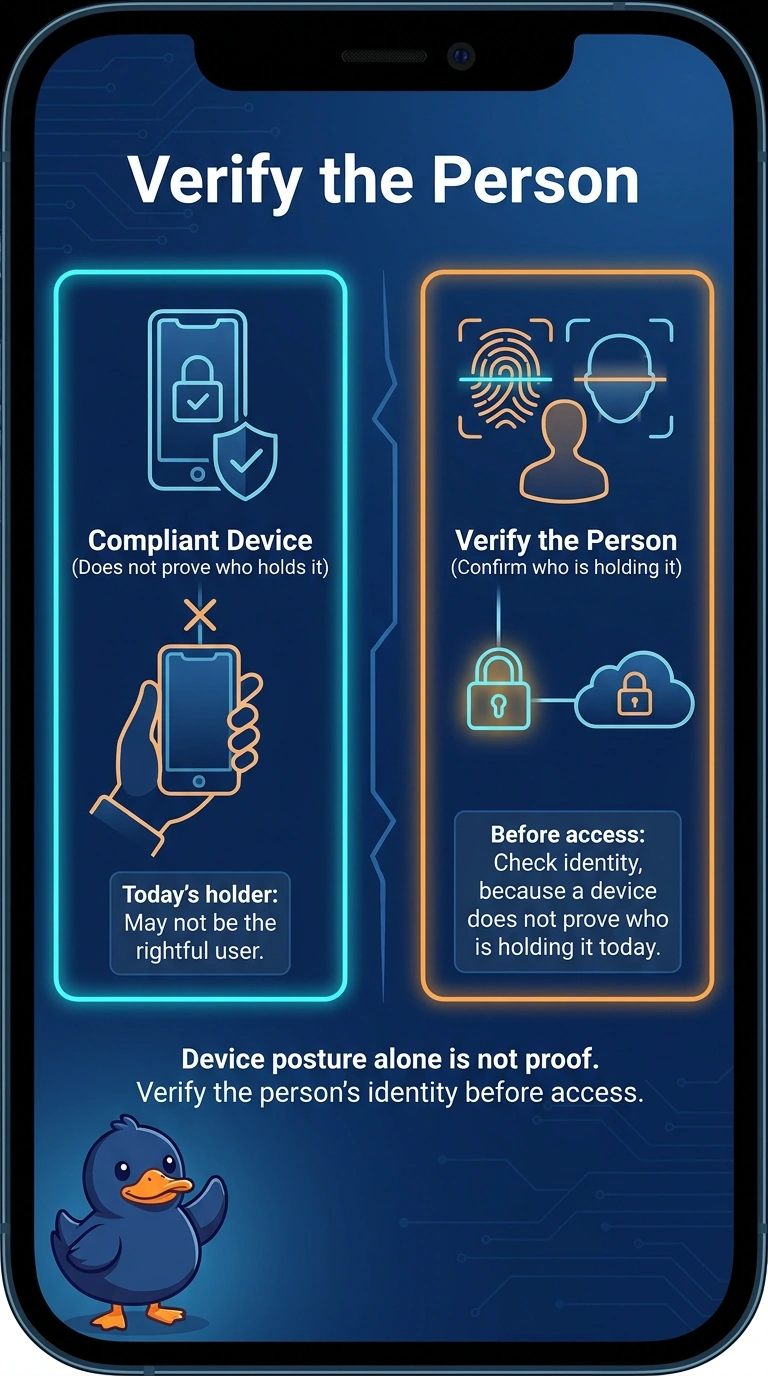
A locked cabinet that still opens for any key cut to the same pattern does not tell you who turned the lock. You still have to check the person's identity, because a stolen laptop can keep a healthy posture score. The trap is reading a managed profile, last quarter's report, or an encryption pass as proof of the rightful user.
Full Explanation
Endpoint posture reports the health and ownership of the device at access time. Disk encryption, current patches, and a managed profile can all be true on a laptop that was stolen, and none of those signals name the person holding it. The person's identity still has to be checked, because a compliant device does not prove who is holding it today. The managed-device profile alone is evidence the laptop is managed, not a substitute for the teacher's identity, so skipping a fresh sign-in leaves the thief authenticated by the hardware. Last quarter's posture report is a stale snapshot, and accepting it as proof of the rightful owner confuses an old health result with a live identification. The encryption and patch results by themselves describe configuration. They are not an authorization decision that identifies the user. Exam caveat: posture and identity are separate inputs, and a pass on one does not satisfy a requirement for the other. Operational check: confirm the access rule still requires a current user authentication even when the endpoint agent reports a compliant managed profile.