
University finance access must hard-fail when disk encryption is missing, but a colleague attaches a warn-only posture profile to that rule. Which profile matches the finance requirement?
Select an answer to reveal the explanation.
Short Explanation
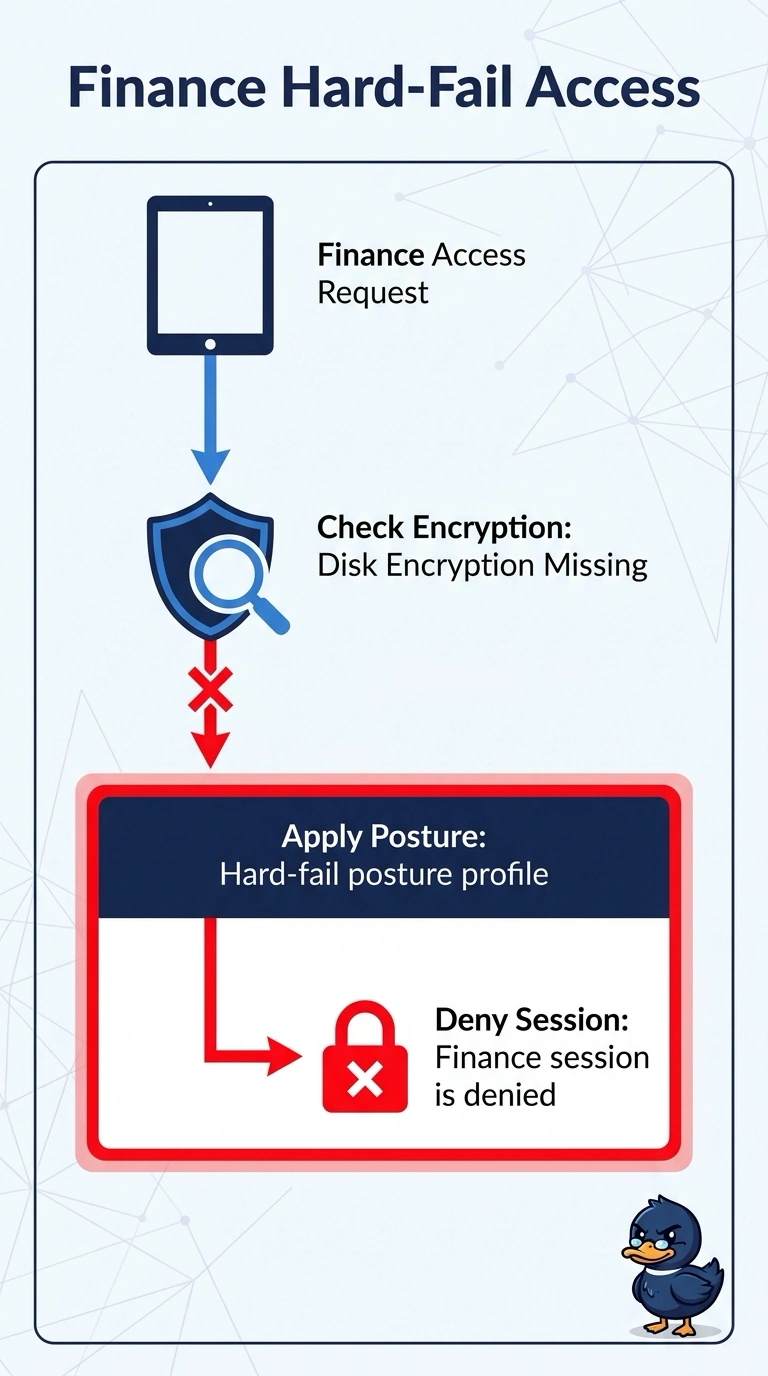
A smoke alarm that only blinks is the wrong device when the rule says to stop the line. You attach the hard-fail posture profile that denies access when disk encryption is missing. The trap is a warn-only profile that notes the gap and still lets the finance session through.
Full Explanation
The finance requirement is a hard failure when disk encryption is missing, so the posture profile has to deny the session rather than warn. The hard-fail posture profile that denies the finance session when disk encryption is missing is the profile that matches that requirement. The warn-only posture profile that records the encryption gap and still allows the finance session documents the miss and then permits the user, which contradicts a hard-fail rule. A browser header check that does not measure disk encryption is a weaker signal and is not an encryption control at all. A full disk-encryption check needs the endpoint agent. Last quarter's saved posture report, reused as a one-time document in place of a live encryption check, is stale. A pass from an earlier term does not describe the laptop today. Exam caveat: warn and deny are different outcomes. Match the profile action to the written requirement, not to the softer profile that happens to be attached. Operational check: open the finance access rule and confirm the attached posture profile denies noncompliant devices instead of warning.