
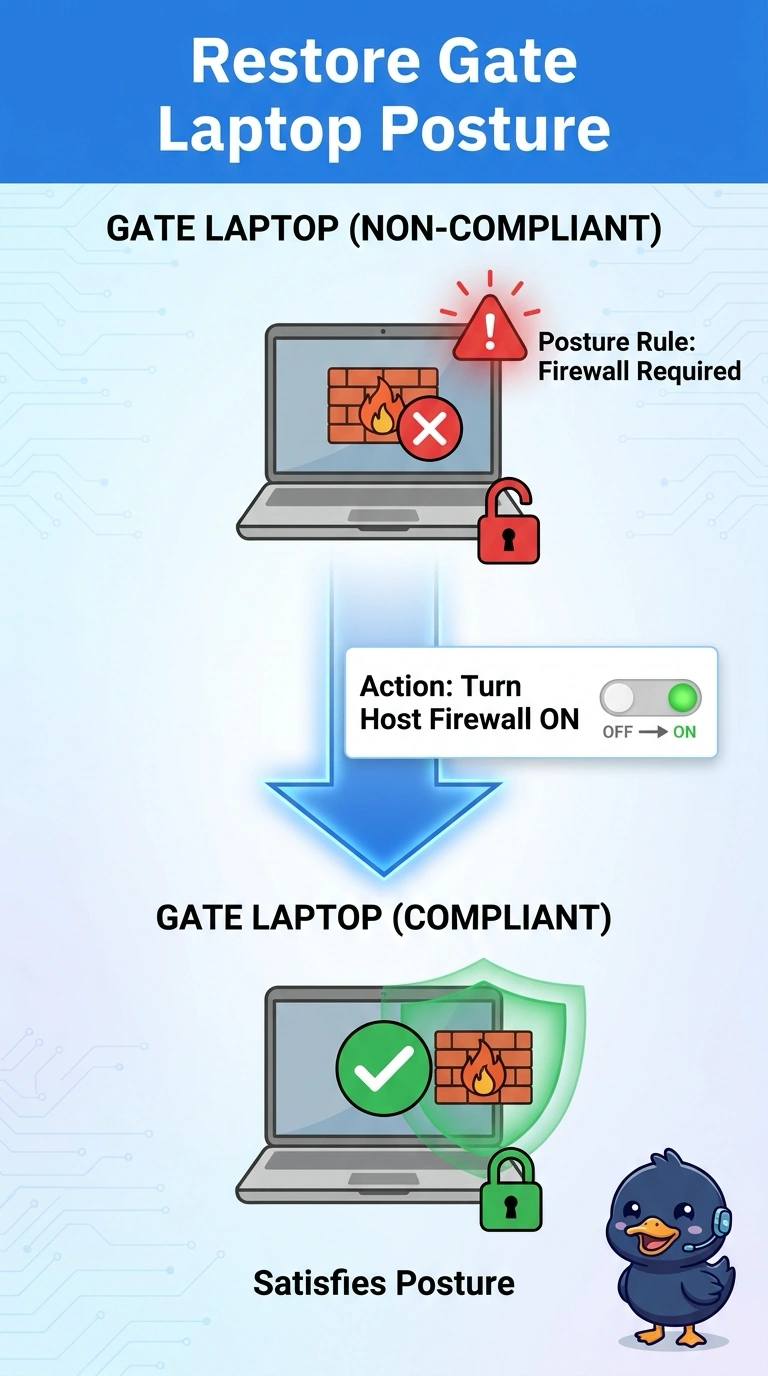
An airline gate laptop fails endpoint posture because its host firewall is off, and the access rule requires that firewall to be enabled. What corrects this failure?
Select an answer to reveal the explanation.
Short Explanation
A spotless cabin aisle does not latch the door. You turn the host firewall on, because that is the control the posture rule is actually asking about. The trap is waving through a clean malware scan, a valid certificate, or an old pass that never looked at the firewall today.
Full Explanation
Endpoint posture checks the health items the policy names, and here the rule requires the host firewall to be enabled. Turn the host firewall on, because that is what makes this gate laptop match that rule, and leave the other signals for the questions they actually answer. A certificate, a malware scan, and a stored pass can all look reassuring while the firewall the rule named is still off. A clean malware scan answers a different question about malicious software and is not a substitute for the host firewall requirement. A new user certificate proves possession of a key during its validity window and says nothing about whether the host firewall is enabled. Reusing last quarter's posture pass skips the check the policy wants on this request and treats a stale result as current. Exam caveat: posture is not the user's identity, so fixing the firewall setting still leaves sign-in to be decided on its own. Operational check: enable the host firewall, request access again, and confirm the posture detail for this attempt reports the firewall as enabled.