
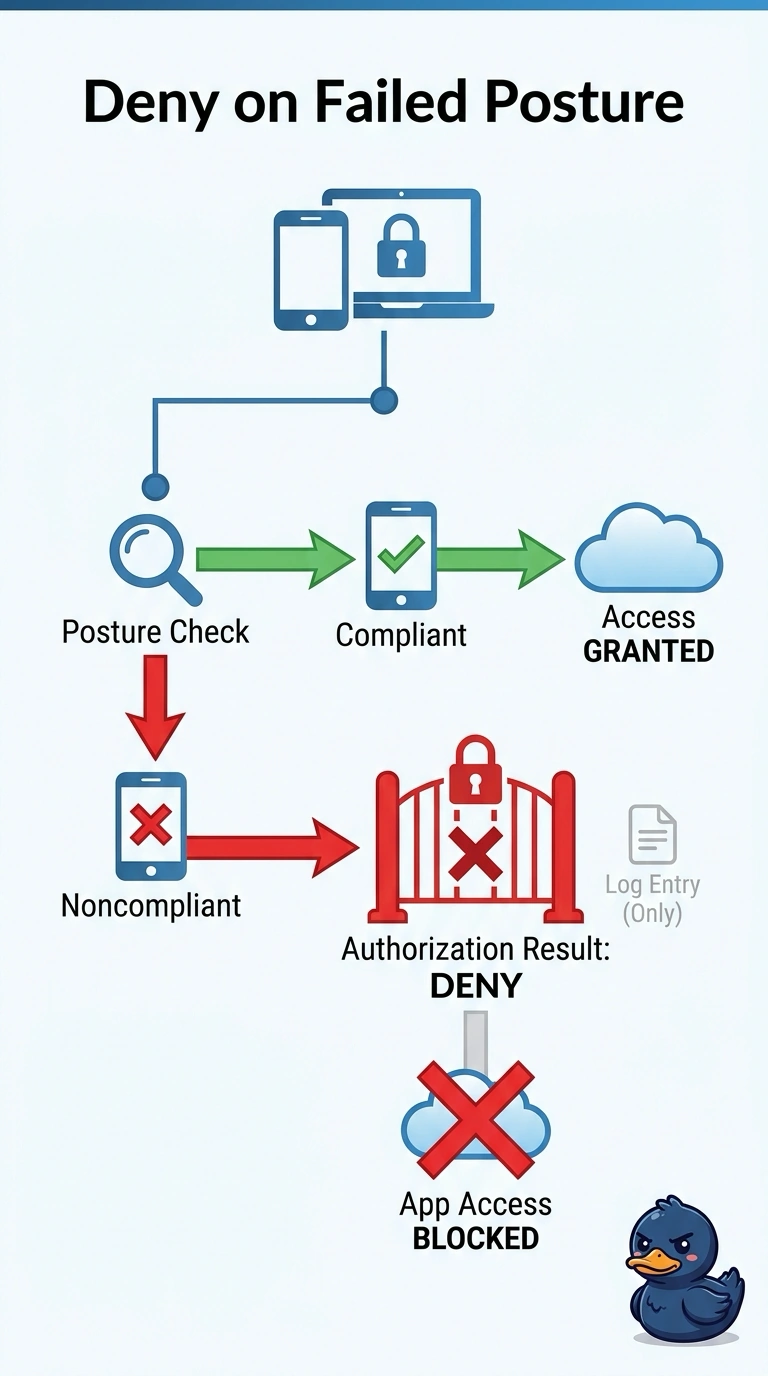
A university policy says noncompliant devices must be denied, yet a failed posture check is only written to a log and the requested application is still granted. What has to change?
Select an answer to reveal the explanation.
Short Explanation
Writing a failed quiz in the grade book does not withhold the credit. You change the authorization result so a failed posture check denies the application, because a log line is not a deny. The trap is adding another log, swapping in a sign-in that never measures the device, or trusting a browser header.
Full Explanation
When policy says noncompliant devices are denied, a failed posture check has to change the authorization result and deny the application instead of only writing a log entry. Copying the failure into a second log destination records it twice and still grants the application, so recording it does not change the authorization. A SAML sign-in authenticates the user and does not remove the device from service when the person later leaves, nor does it measure posture. A browser header is a weaker signal than an endpoint posture result and cannot honestly treat a failed device as compliant without an endpoint agent. Exam caveat: posture is the device check at access time, and identity proof alone does not satisfy a rule that noncompliant devices are denied. Operational check: fail a test device on purpose and confirm the application response is a deny, with the log as a record of that deny rather than the only outcome. If the application still opens, the authorization result has not been tied to the posture failure.