
A clinic laptop is behind the required patch level, so posture fails when a clinician opens the charting application. What actually clears that posture failure?
Select an answer to reveal the explanation.
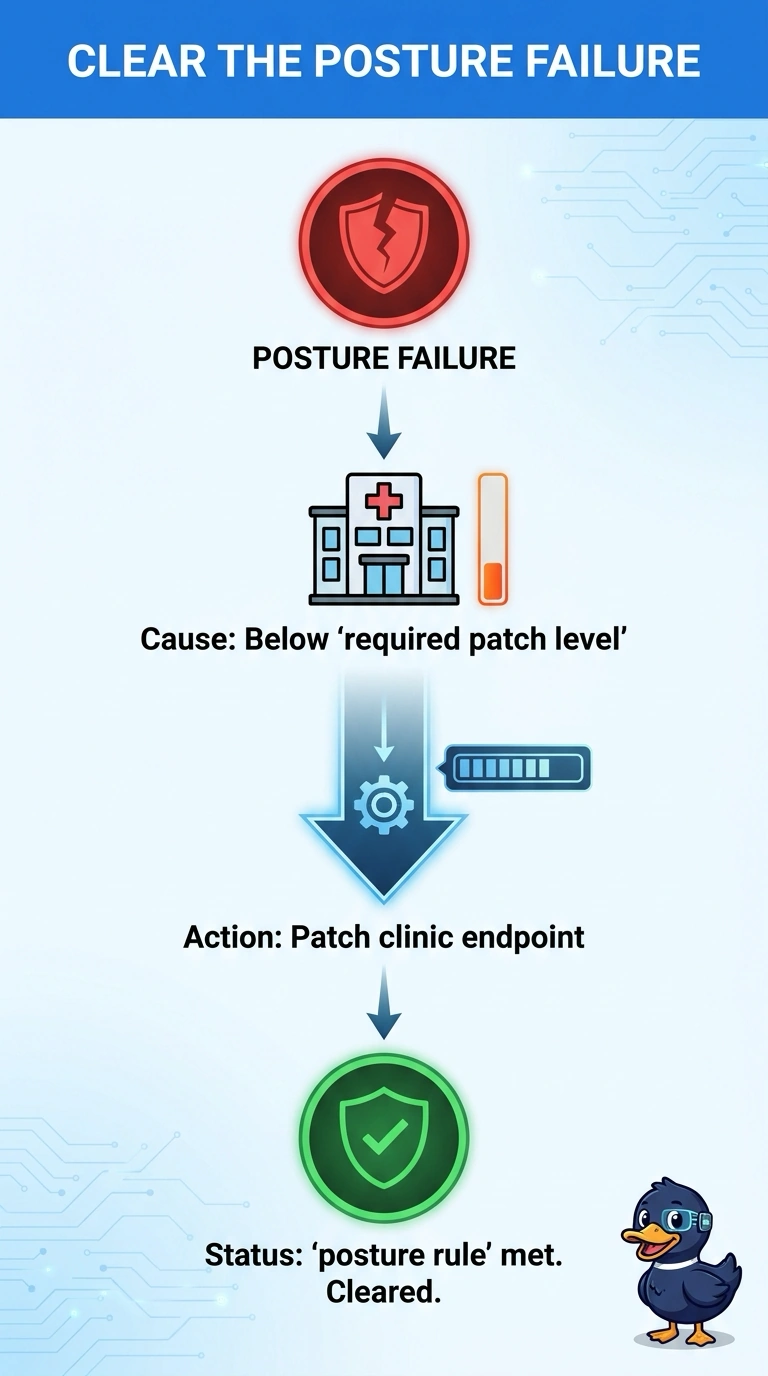
Short Explanation
Worn brakes are fixed by replacing the brakes, not by cutting a hole in the fence. You patch the clinic endpoint until it meets the patch level the posture rule checks. The trap is a new user certificate, an open firewall port, or ordinary push on a phone, none of which patch the laptop.
Full Explanation
Posture evaluates the endpoint at access time, and a rule that requires a patch level fails until the device meets that level. Patching the clinic endpoint until it meets the required patch level that the posture rule checks is the change that clears this failure. Issuing a new user certificate marks a credential as valid. A certificate does not install missing updates, and marking the endpoint compliant without changing its software falsifies the check. Opening a firewall port toward the clinical application makes a path reachable. The posture rule is not a port rule, so reachability leaves the unpatched laptop noncompliant. Clearing the failure by enrolling the clinician for ordinary Duo Push improves a sign-in method on a phone. Push enrollment does not change the laptop's patch level, and it does not satisfy a device-health rule. Exam caveat: a posture pass from an earlier quarter is stale. The check that matters is the one at this access, after the patches are actually present. Operational check: after patching, refresh the posture report and confirm the charting application allows the session only once the endpoint shows the required patch level.