
A university administrator is traveling with a laptop and a roaming security key that was enrolled earlier with a PIN. The phone was left on campus, and the Duo policy forbids SMS. Which method still satisfies a phishing-resistant sign-in?
Select an answer to reveal the explanation.
Short Explanation
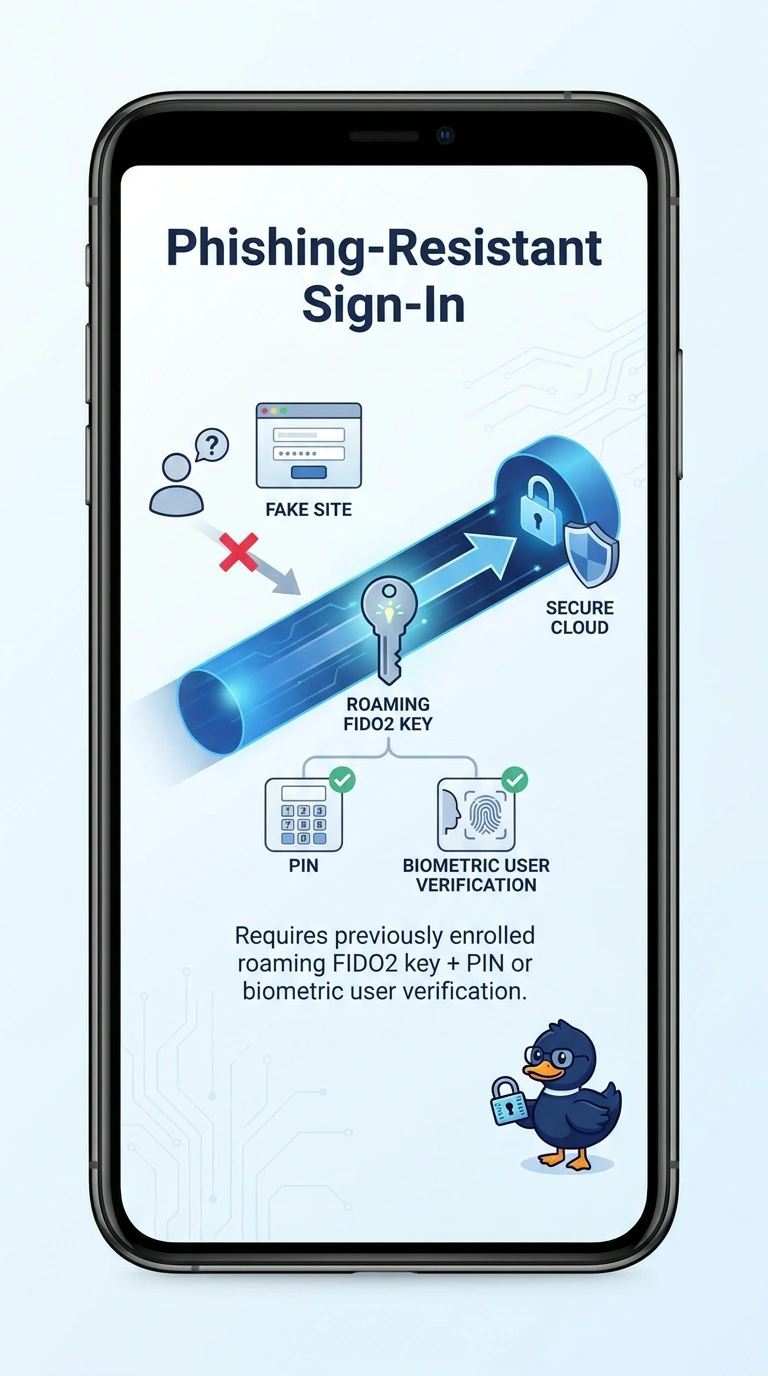
A key on your own keyring still opens the door when the phone is sitting at home. You use the roaming security key with its PIN or biometric, which stays phishing-resistant without that phone. The trap is SMS, an ordinary push, or a passkey that lives on a different computer.
Full Explanation
A roaming FIDO2 key that the user already enrolled, completed with PIN or biometric user verification, is one of the phishing-resistant methods, and it does not need the phone that was left on campus. The policy forbids SMS, so the trip does not fall back to a text. An SMS one-time code fails twice: the policy bans it, and SMS is not phishing-resistant, even if the campus phone could receive it. Ordinary Duo Push can be relayed by a real-time phishing proxy, so a push approved from a look-alike page is not phishing-resistant, and there is no phone on the trip to receive it anyway. A device-bound credential registered on the office desktop is unavailable on the borrowed laptop. A synced passkey would require access to its passkey provider on that laptop. Exam caveat: phishing-resistant here means the method is bound so a look-alike site cannot relay it, which ordinary push and SMS do not provide. Operational check: sign in on the travel laptop with the roaming key and its PIN, and confirm the account did not offer SMS or an ordinary push.