
A newly issued user certificate succeeds on every hospital workstation except one laptop whose clock is several hours behind. The laptop is the relying party validating the certificate, and its local clock is earlier than the certificate's notBefore value. What should the technician correct first?
Select an answer to reveal the explanation.
Short Explanation
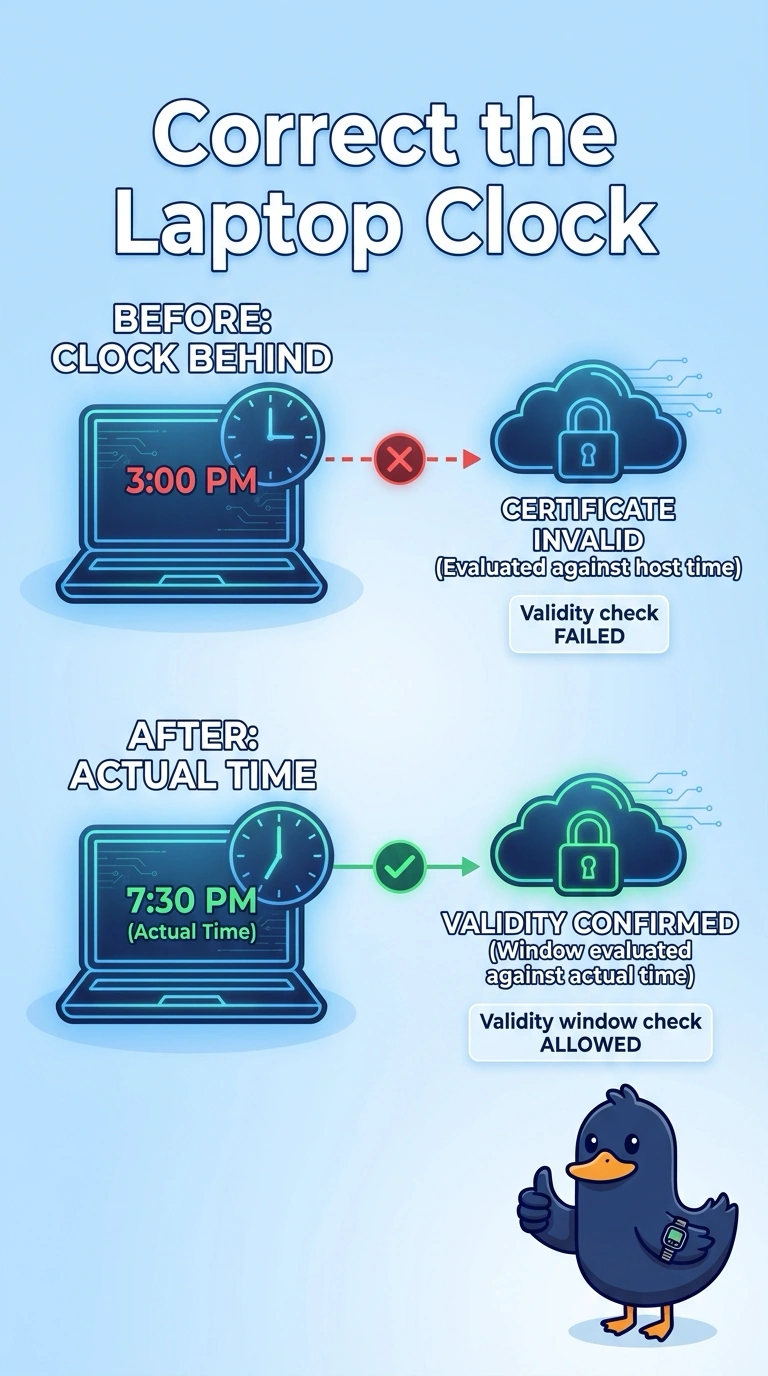
A shop that still thinks it is yesterday will refuse a coupon that is perfectly good today. You correct the laptop clock so the new certificate validity window is judged on the real time. The trap is revoking a certificate that every other workstation already accepts.
Full Explanation
A relying party accepts a certificate only inside its validity window, and that comparison uses the local clock. This certificate already succeeds everywhere else, so the laptop clock being hours behind is what makes a still-valid certificate look unacceptable. Correcting the laptop clock lets the validity window be evaluated against the actual time. Revoking the new user certificate would retire a credential that every other workstation accepts and would not fix the skewed clock. Reissuing from a web-server template whose extended key use is only server authentication would make the certificate fail client use on every machine, including the ones that work today. Exporting the private key to a file share copies the credential onto a share and does not change how this laptop evaluates time. Exam caveat: a certificate that is genuinely outside its validity window should fail everywhere, so a single-host failure is a clue to look at that host's clock before revoking. Operational check: set the laptop clock from a trusted time source, confirm the skew is gone, and retry the sign-in without reissuing the certificate.