
An accounting firm can leave the internal wiki on a basic factor, but payroll must use a phishing-resistant authenticator. Where should that stricter method be required?
Select an answer to reveal the explanation.
Short Explanation
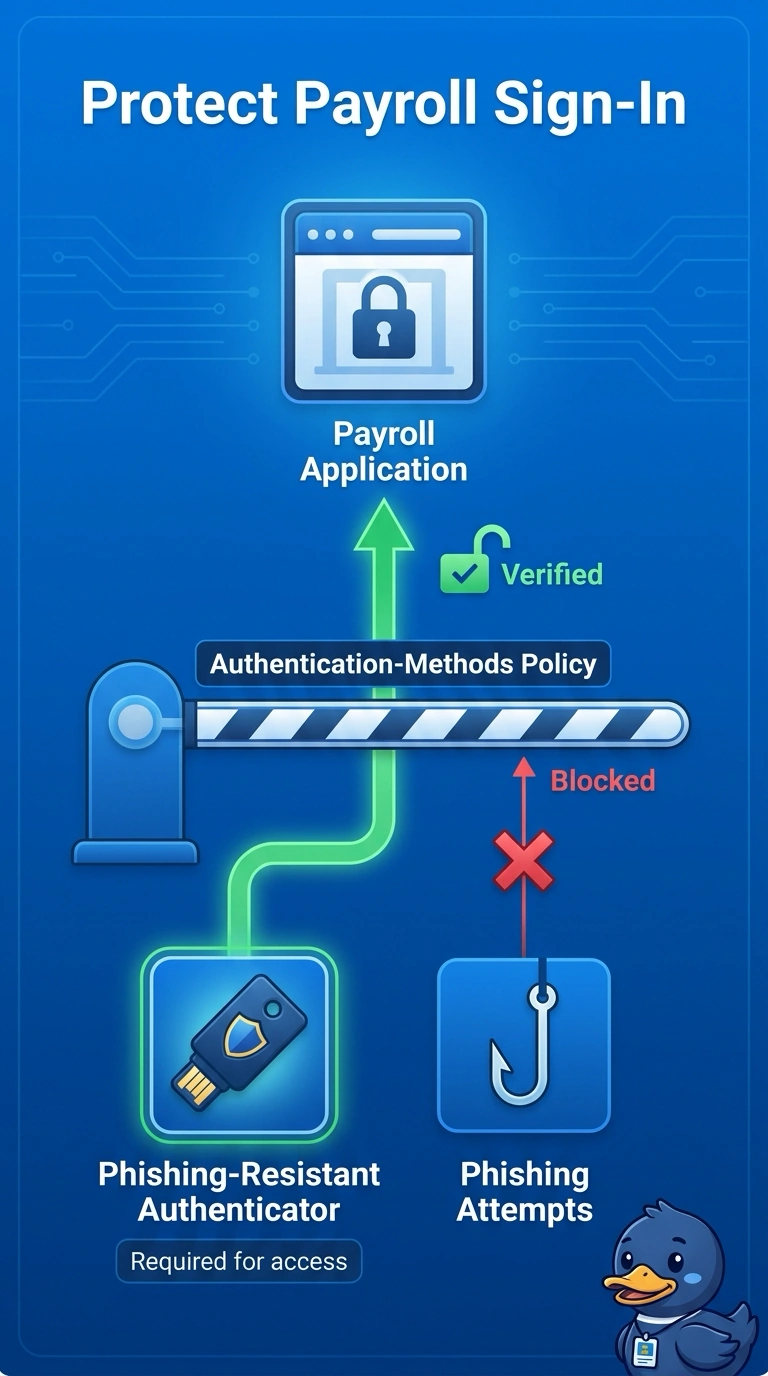
A lobby badge and a vault key are not the same tool, and you do not hang the vault key on the lobby door. You require the phishing-resistant authenticator on the payroll application and leave the wiki on its basic factor. Guest wireless and a spam filter do not perform that sign-in.
Full Explanation
Authentication strength is applied to the application that needs it. The stricter method belongs on the payroll application, using an authentication-methods policy that requires a phishing-resistant authenticator, while the wiki can stay on a basic factor. The choice to put it on the internal wiki, so the payroll application inherits the same basic factor the wiki already accepts today, aims the weak method at the wrong application and assumes payroll inherits the wiki's factor. The choice to put it on the office guest wireless network, so joining that network is treated as a substitute for a phishing-resistant payroll sign-in, replaces an authenticator with a network association, which does not bind the payroll sign-in to the genuine site. The choice to put it on the mail security filter, so spam scanning is treated as a stand-in for stronger sign-in to the payroll application, confuses mail filtering with authentication of the payroll user. Exam caveat: phishing-resistant methods are a platform authenticator, a roaming FIDO2 key with user verification, or Duo Mobile Push with Bluetooth proximity, and the policy can require one of those on payroll alone. Operational check: compare the allowed methods on the payroll application with the methods on the wiki and confirm only payroll demands the phishing-resistant authenticator.