
A clinic help desk wants SMS one-time codes for privileged payroll sign-in because staff already know how to use their phones. Which statement matches Duo's guidance?
Select an answer to reveal the explanation.
Short Explanation
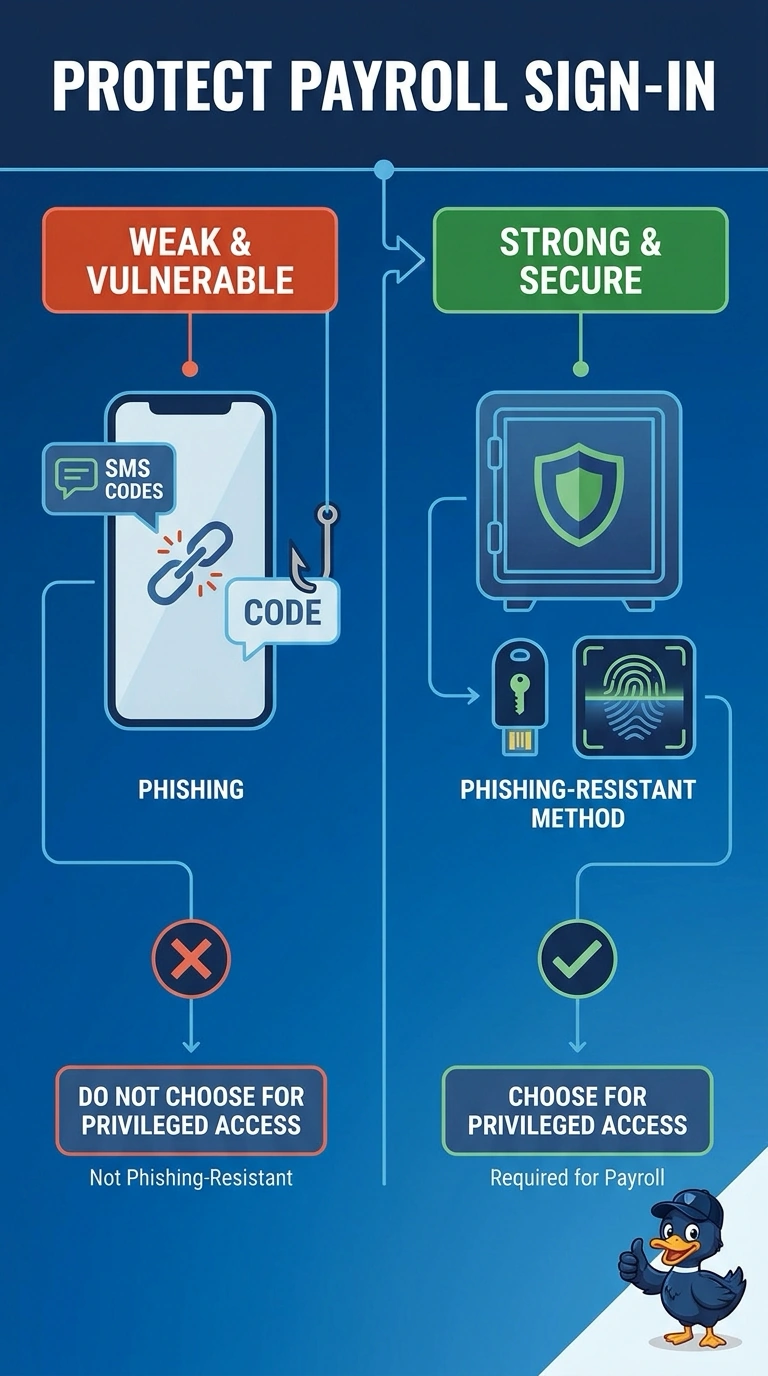
Texting a door code to a phone is convenient, and it is also easy for someone else to catch. You refuse SMS for privileged payroll access, because that method is not phishing-resistant under Duo's guidance. A familiar phone does not turn a text code into a passkey.
Full Explanation
Privileged payroll access is exactly where a phishing-resistant method belongs, and SMS is not in that set. SMS is not a phishing-resistant method, so it should not be the factor chosen for privileged payroll access, no matter how familiar the handset is. The claim that SMS meets the phishing-resistant bar for payroll when the phone number is already stored in the clinic directory confuses a directory listing with a cryptographic bind to the genuine site. The claim that SMS is acceptable for privileged payroll when ordinary Duo Push is also turned on for that same account stacks two methods that both fall short of the phishing-resistant bar, since ordinary push can be relayed by a real-time proxy. The claim that SMS qualifies for payroll because a texted code is bound to the genuine site in the same way a passkey is misstates the method: a platform passkey is bound to the site, and a text code is not. Exam caveat: the phishing-resistant methods in Duo's guidance are a platform authenticator, a roaming FIDO2 authenticator with user verification, and Duo Mobile Push with Bluetooth proximity. Operational check: open the payroll application's allowed methods and confirm SMS is not permitted for that privileged group.