
A school district finds administrators are being phished by a real-time proxy that relays ordinary Duo Push approvals to the genuine sign-in. Which change matches Duo's guidance for that attack?
Select an answer to reveal the explanation.
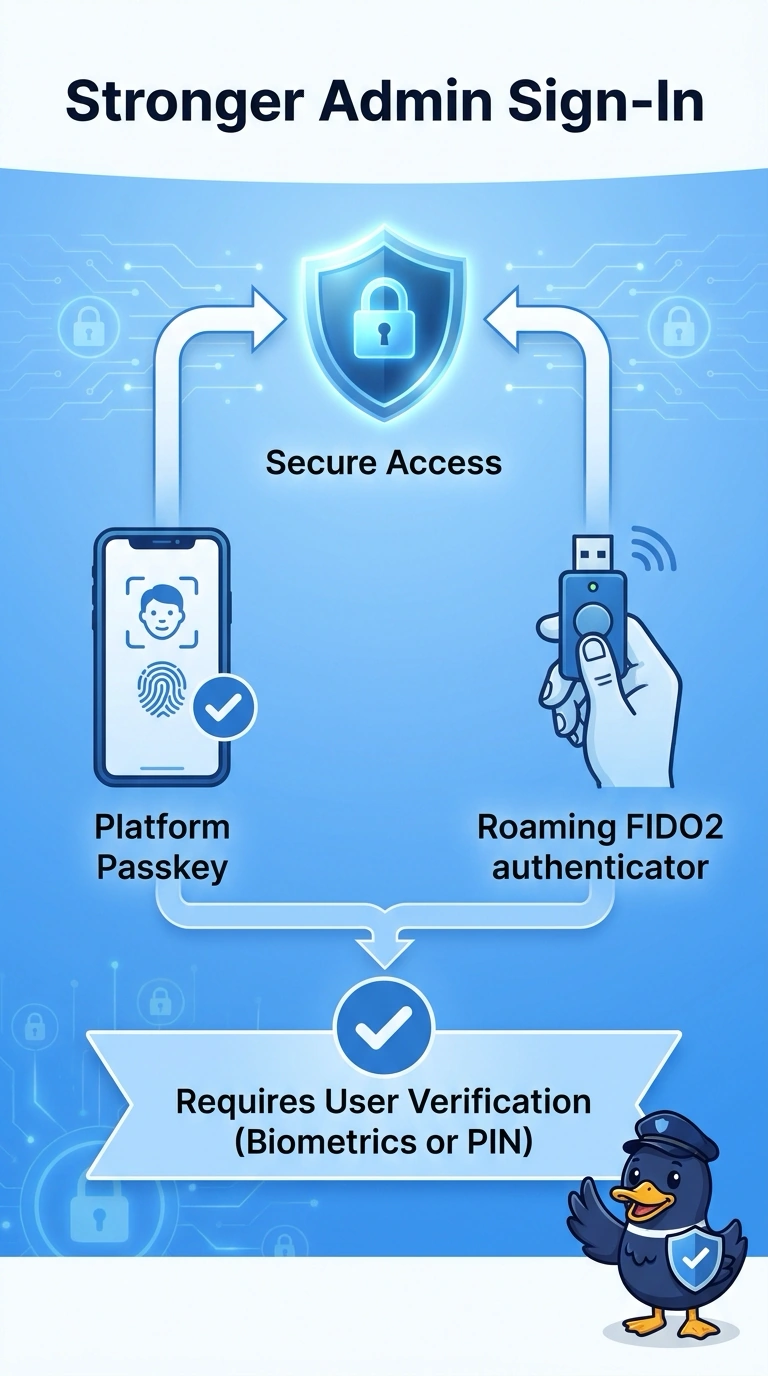
Short Explanation
Picture a fake storefront that rings the same doorbell you already trust, then pockets whatever you hand over. You move those administrators onto a passkey or a roaming security key with user verification, because ordinary Duo Push is not bound to the genuine site. Adding a text code, trusting the school network, or shortening the timer does not give you a phishing-resistant method.
Full Explanation
A real-time phishing proxy sits between the administrator and the genuine sign-in and relays ordinary Duo Push, because that push is not cryptographically bound to the real site. Duo’s guidance is to move those administrators to a platform passkey or a roaming FIDO2 authenticator that requires user verification; both methods are phishing-resistant. Keeping ordinary Duo Push and adding familiar SMS codes leaves the push relayable, and SMS is not phishing-resistant. Treating a sign-in from the school network as proof against phishing trusts where the session appears to come from; it does not bind the approval to the genuine site. Shortening the Duo Push timeout and accepting prompts from any address the proxy presents only makes the same unbound push expire sooner. Exam caveat: Duo also counts Duo Mobile Push with Bluetooth proximity as phishing-resistant, while ordinary push and SMS stay outside that set. Practical check: review the administrator group’s authentication policy and confirm that it allows a platform passkey or a roaming FIDO2 key with user verification, and does not offer ordinary push.