
Clerks at a courthouse keep approving Duo Push prompts they did not start after a flood of prompts hits their phones. Which description fits this failure?
Select an answer to reveal the explanation.
Short Explanation
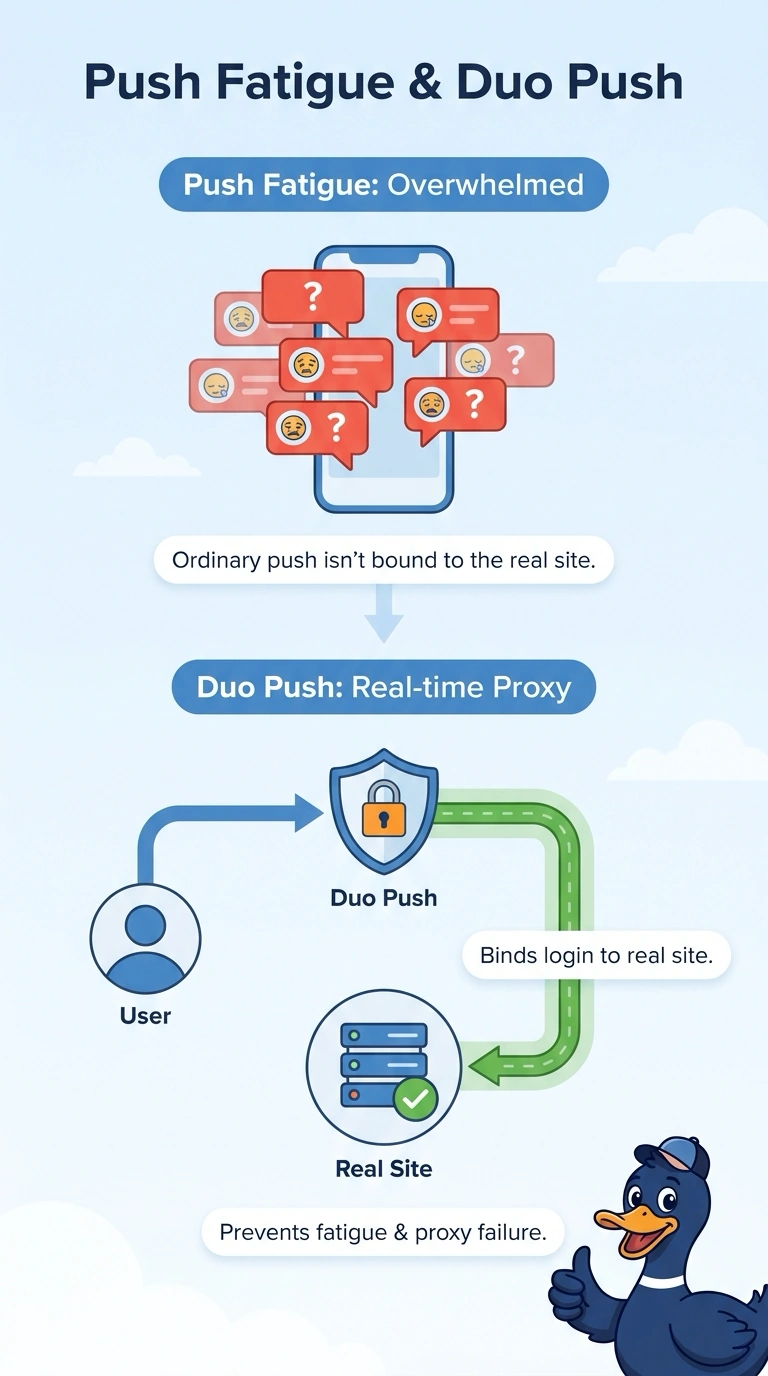
When you see staff approving a flood of prompts they did not start, you can recognize push fatigue: tired people may tap yes just to stop the noise. It is different from a real-time proxy, and ordinary Duo Push does not bind the login to the real site. Shortening the timer while staying on ordinary push does not fix either problem.
Full Explanation
When clerks approve a flood of prompts they did not start, the failure is push fatigue: repeated prompts can wear users down until they approve one just to stop the interruptions. Push fatigue is different from a real-time phishing proxy, and ordinary Duo Push does not bind the login to the genuine site. The fitting description is to call this push fatigue, distinguish it from a real-time proxy, and recognize that ordinary push does not bind the login to the real site. Treating the approvals as a real-time phishing proxy and shortening the push timer while staff remain on ordinary Duo Push misidentifies the failure and leaves the unbound push method in place. Treating unexpected prompts as an expired device certificate and reissuing user certificates to every courthouse workstation addresses a certificate problem that the prompts do not indicate. Treating the prompts as a text-message problem and moving privileged clerks to SMS codes because their phones feel familiar substitutes SMS, which is not phishing-resistant. Exam caveat: push fatigue and a real-time proxy are distinct failures, and coaching users to reject unexpected prompts does not prevent ordinary push from being relayed. Practical check: review authentication logs for a burst of prompts clerks did not initiate, then move privileged applications toward a phishing-resistant method rather than relying on a shorter ordinary-push timer.