
A hospital identity provider marks a clinician high risk, while the scheduling application shows no local risk score. Which signal should the access decision consume?
Select an answer to reveal the explanation.
Short Explanation
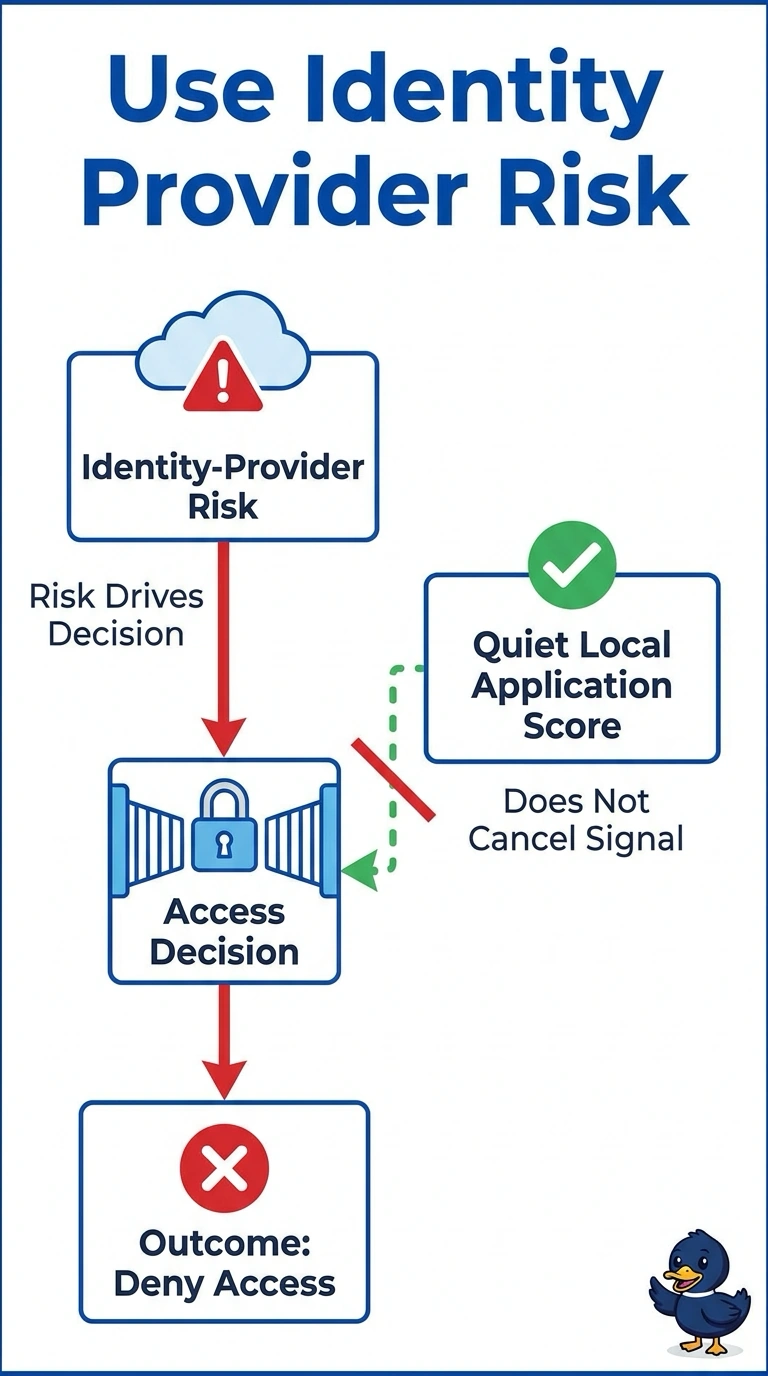
Think of a fire alarm in the lobby while the cafe downstairs looks perfectly calm. You consume the identity-provider risk, because a quiet local score does not cancel it. The trap is trusting the calm application, a device certificate, or last quarter's posture result to retire today's flag.
Full Explanation
When the identity provider marks a user high risk, the access decision should consume that identity-provider risk. A scheduling application with no local risk score is a quiet application log, and a quiet log does not cancel the identity-provider signal. The scheduling application's missing local score does not clear the identity-provider flag, even though a quiet SaaS log can look reassuring. A device certificate on a shared workstation proves a key the relying party trusts for that device, and it does not identify which clinician is at the keyboard. Last quarter's posture result is stale, and it does not retire the new high-risk flag from the identity provider. Posture and identity risk are different inputs. Exam caveat: a missing local score is not a clean bill, and it must not outrank a current high-risk mark from the identity provider. Operational check: sign in as the flagged clinician and confirm the access policy steps up or blocks from the identity-provider risk even though the scheduling application shows no local score.