
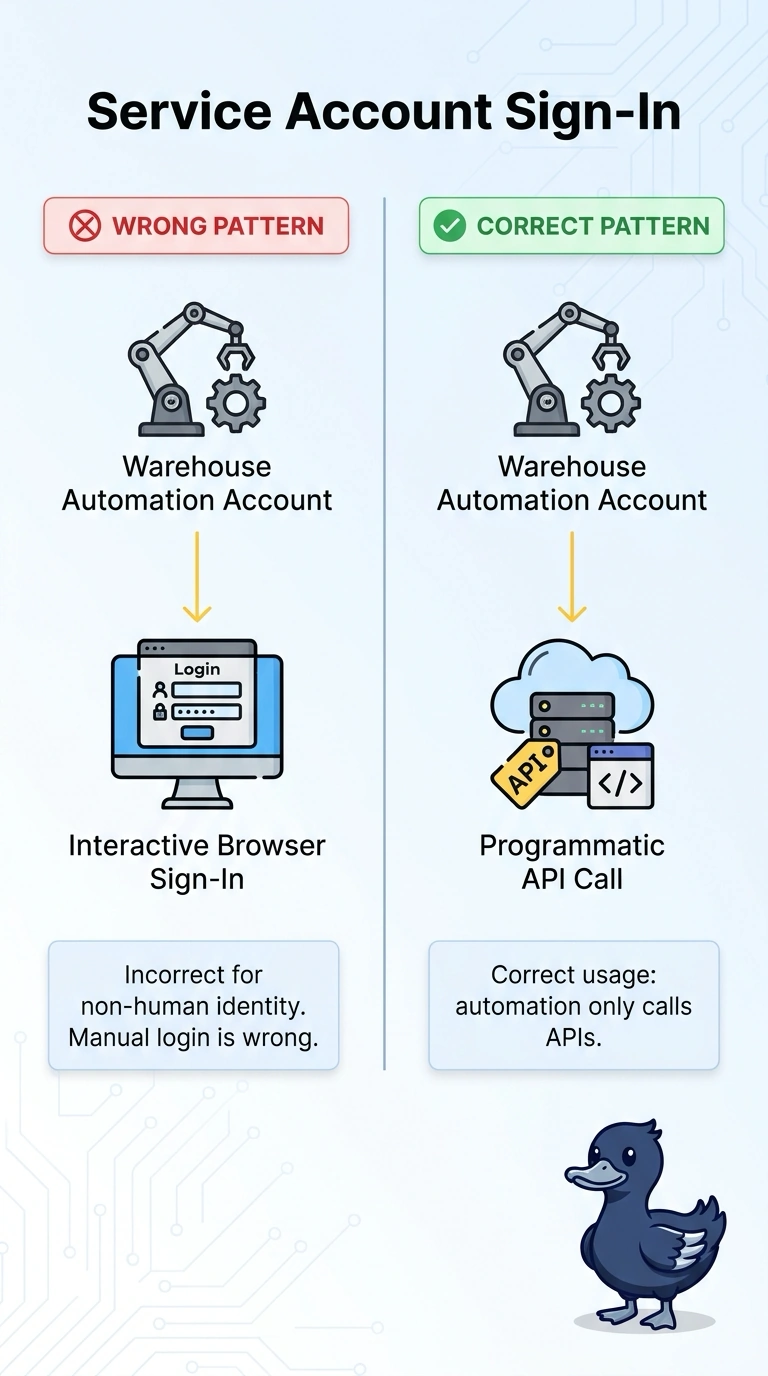
A warehouse automation account that should only call inventory APIs suddenly completes an interactive browser sign-in from a desktop. Which identity finding should the team investigate?
Select an answer to reveal the explanation.
Short Explanation
Think of a service account like a forklift key that belongs on the loading dock, not at the front desk signing the visitor log. You investigate an interactive browser sign-in on that non-human identity because the pattern does not match the way the account is meant to work. The trap is treating a quiet partner tenant, or a password that has not changed, as if the session were fine.
Full Explanation
A service account is a non-human identity built for API calls, so an interactive browser sign-in from a desktop is a mismatch between the account type and the way it was used. Identity intelligence exists to surface that pattern so you can investigate the session, the source address, and who holds the credential. A quiet week in the partner identity provider does not explain the warehouse event, and treating that quiet week as proof that the warehouse account can be ignored sends you to the wrong directory. An unchanged service-account password this quarter does not clear the browser sign-in by itself, because a password that was never rotated can still be stolen and typed into a browser. A directory-wide reset of every human password answers a different population and leaves the non-human session untouched. Exam caveat: identity signals inform the access decision, and they are not a second directory you edit in place of the real account. Operational check: open the sign-in record for that automation account, confirm the session was interactive, and disable it while you find out who used the credential.