
A bank review finds a privileged account that has not signed in for a long time and is still enabled, and no malware indicator is attached to the account. Which finding should be recorded?
Select an answer to reveal the explanation.
Short Explanation
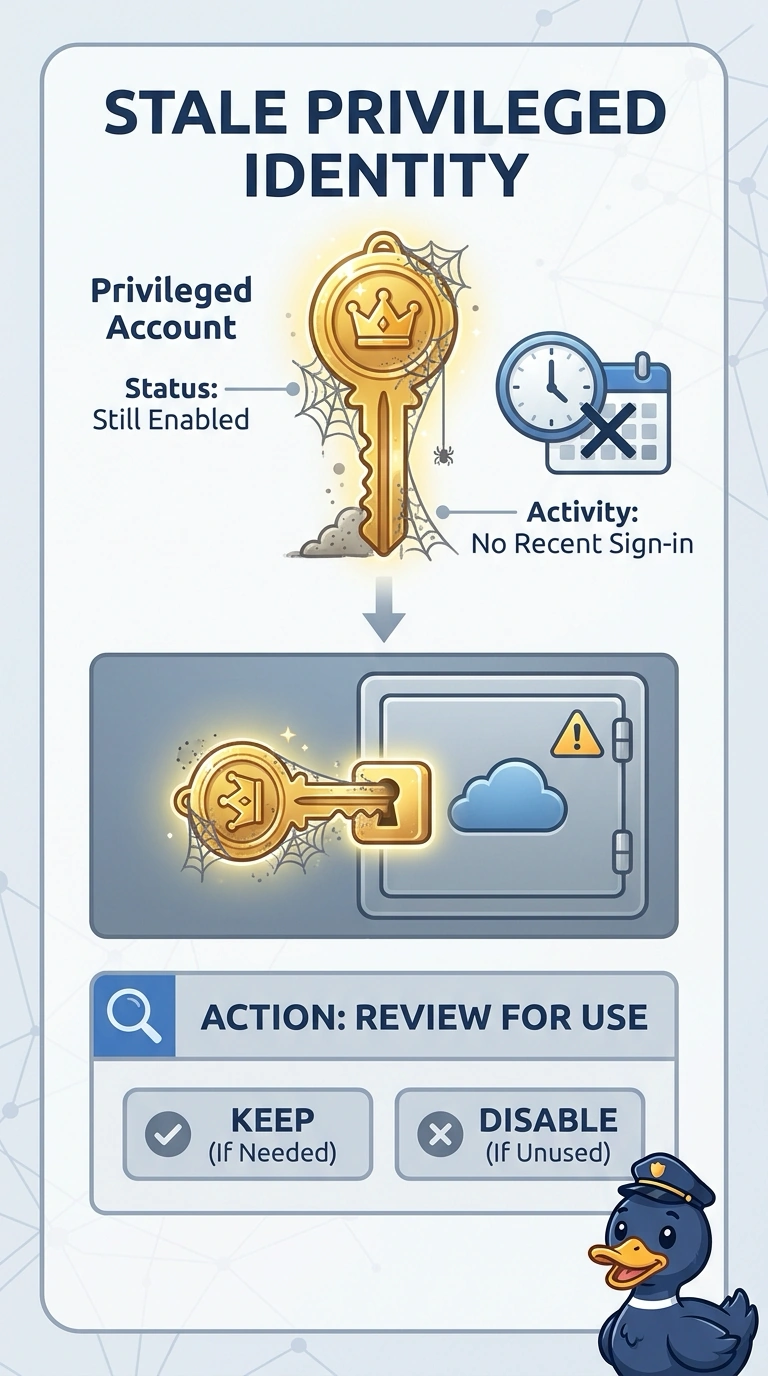
A master key nobody has checked out in ages is still a key on the ring. You are looking at a stale privileged identity that is still enabled, not at a malware hash. A long quiet period does not prove the account is safe to leave alone.
Full Explanation
Identity intelligence treats a privileged account that stays enabled after a long period without a sign-in as a stale privileged identity. That finding is about the account lifecycle, and the review attached no malware indicator. Recording a stale privileged identity that is still enabled, and reviewing whether that account should remain, matches the evidence. Filing the finding as a malware hash because a privileged account with no recent sign-in matches a quiet malicious file imports a malware concept the review did not produce. Disabling the identity provider until every privileged account has completed a fresh interactive sign-in takes the directory down for everyone to answer one stale account. Clearing the finding because a long stretch without a sign-in shows the account is safe to leave enabled reads silence as health, and a quiet privileged account that remains enabled is the risk. On the exam, a stale privileged identity is an identity signal, not a malware hash and not proof the account is harmless. In operations, list enabled privileged accounts with no recent sign-in and confirm each one is reviewed for removal or a renewed, monitored purpose.