
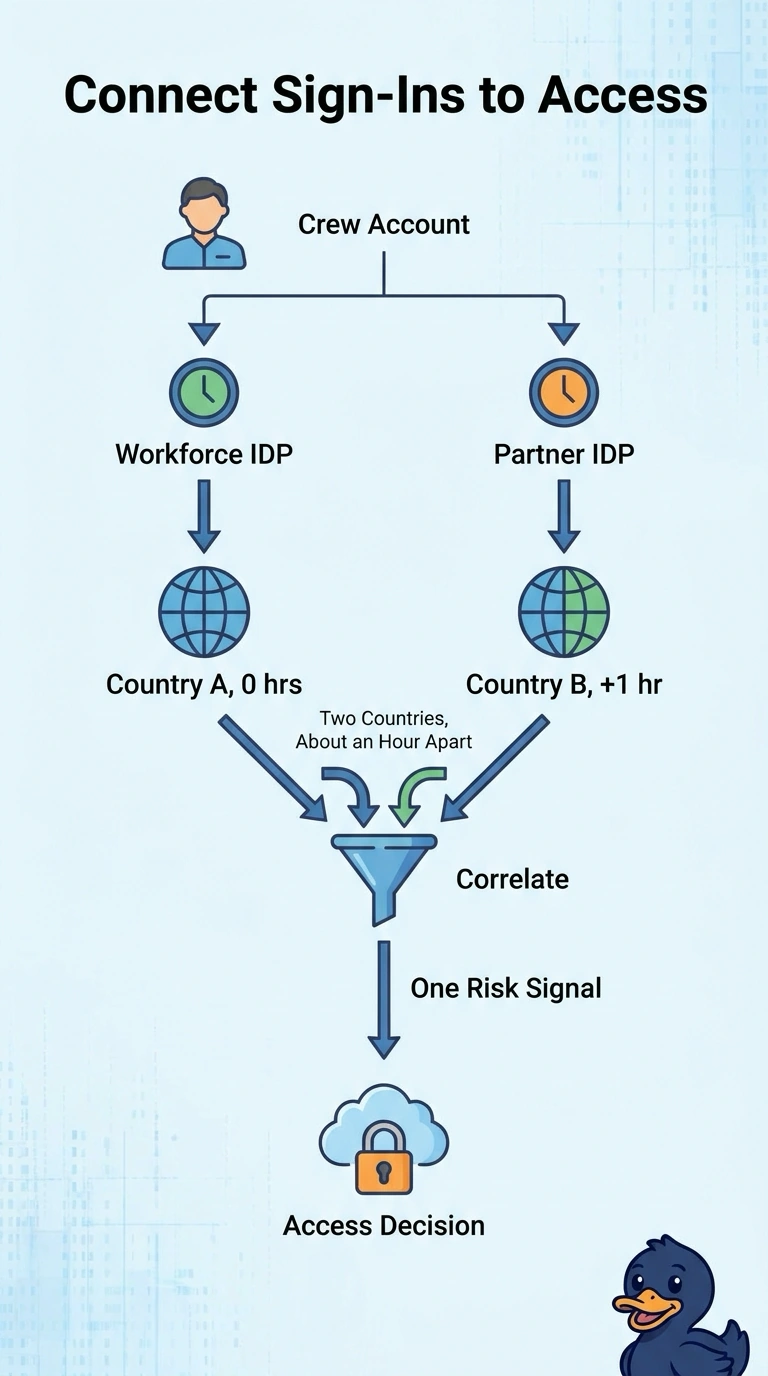
An airline investigator sees the same crew account authenticate from two countries about an hour apart, once in the workforce identity provider and once in the partner identity provider. Which response uses that pair of events correctly?
Select an answer to reveal the explanation.
Short Explanation
You can treat two clocks in different cities as one impossible trip, even if each is accurate on its own. Correlation turns the sign-ins into one risk signal for the access decision. Resetting a password only in the booking application's local store does not erase that pair.
Full Explanation
Identity intelligence collects signals from more than one identity provider and feeds them into an access decision; it is not a directory. Two sign-ins an hour apart can indicate impossible travel when the same identity is confirmed and the distance between reliable sign-in locations makes that travel implausible; a successful authentication inside each provider does not make the combination benign. Correlating the two identity-provider sign-ins as one risk signal and feeding that signal into the access decision uses the cross-provider pattern appropriately. Resetting the password only inside the airline booking application's local password store addresses an application credential store that did not see that pattern; a quiet application log does not cancel a risk signal from the identity providers. Disabling the second identity provider because two directories cannot both be right confuses correlation with a broken tenant: both providers can be healthy and still describe one risky journey. Ignoring the sign-ins because each provider accepted the password it checked treats two local successes as a pardon. On an exam, remember that impossible travel across providers should affect the access decision, not prompt deletion of a tenant. In operations, confirm that the policy for this crew account consumes events from both identity providers and can step up or deny the session.