
A warehouse fulfillment platform runs on a private Kubernetes cluster. The team needs pod-identity network policy and flow visibility for east-west traffic between order pods and inventory pods. Which tool does that job?
Select an answer to reveal the explanation.
Short Explanation
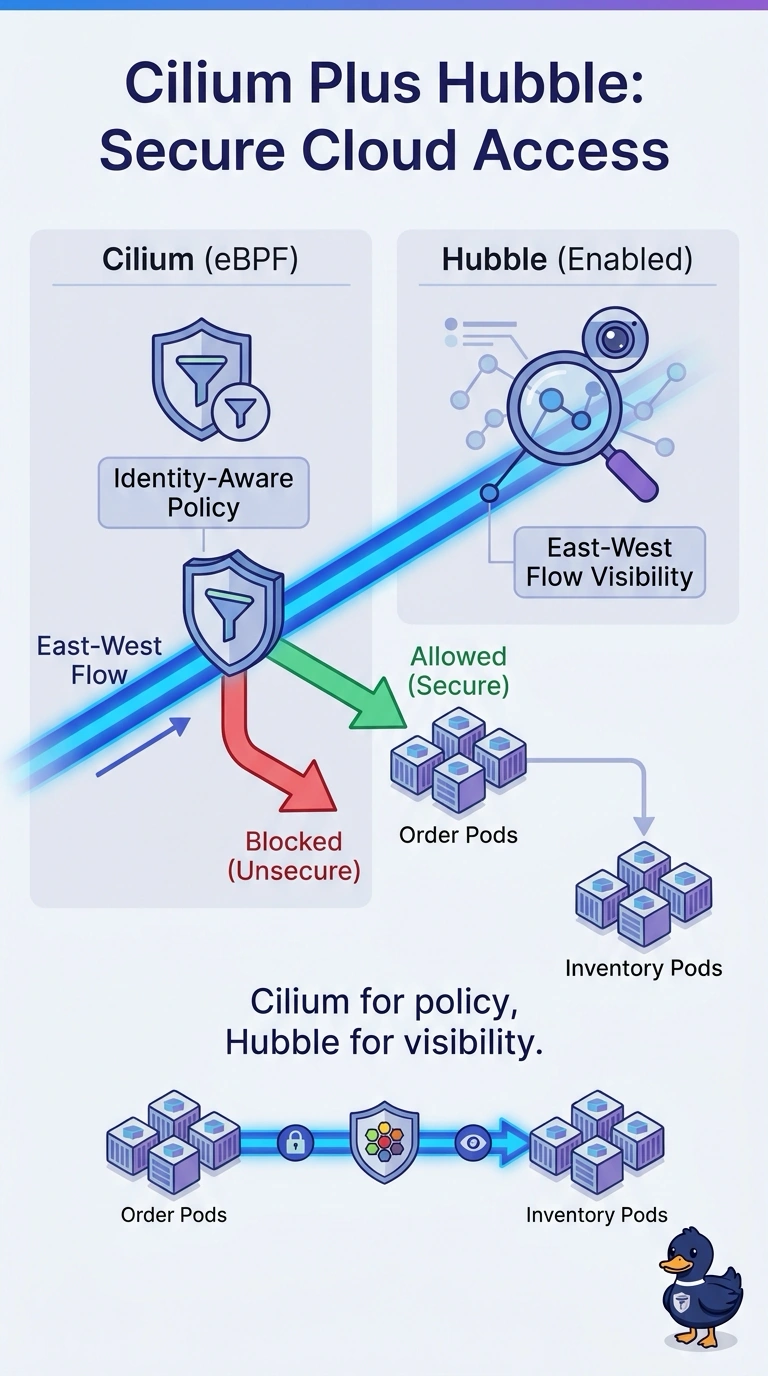
You hire a traffic cop for the streets, not a detective who tackles people inside the building. Cilium applies identity-aware network policy, and Hubble shows the east-west flows when enabled. A runtime kill of a process answers a different question than which pods may talk.
Full Explanation
East-west pod traffic needs a data plane that understands pod identity, applies network policy, and records the flows. That is Cilium for identity-aware network policy, with Hubble enabled for east-west flow visibility. Use Cilium to enforce the policy and Hubble to observe the flows between order pods and inventory pods. Tetragon is the runtime sensor that can watch a process and end it. It does not assign pod network identity, and it does not replace network policy for those east-west flows. The namespace alone is a naming boundary. Putting both workloads in one namespace does not enforce who may connect until a network policy is applied. A hypervisor port group can group virtual interfaces on the switch. Labeling that group does not create pod identity or enforce pod network policy by itself. Exam caveat: a policy that is only stored and not enforced does not segment the pods, and a quiet flow log is not proof that the policy is doing the job. Operational check: confirm the order-to-inventory flow is visible in Hubble and that a pod outside the allowed identity is denied by the network policy.