
A bank moves a payments workload from a public cloud onto its own hypervisor cluster, then removes identity checks because the workload is no longer in a public cloud. What is wrong with that decision?
Select an answer to reveal the explanation.
Short Explanation
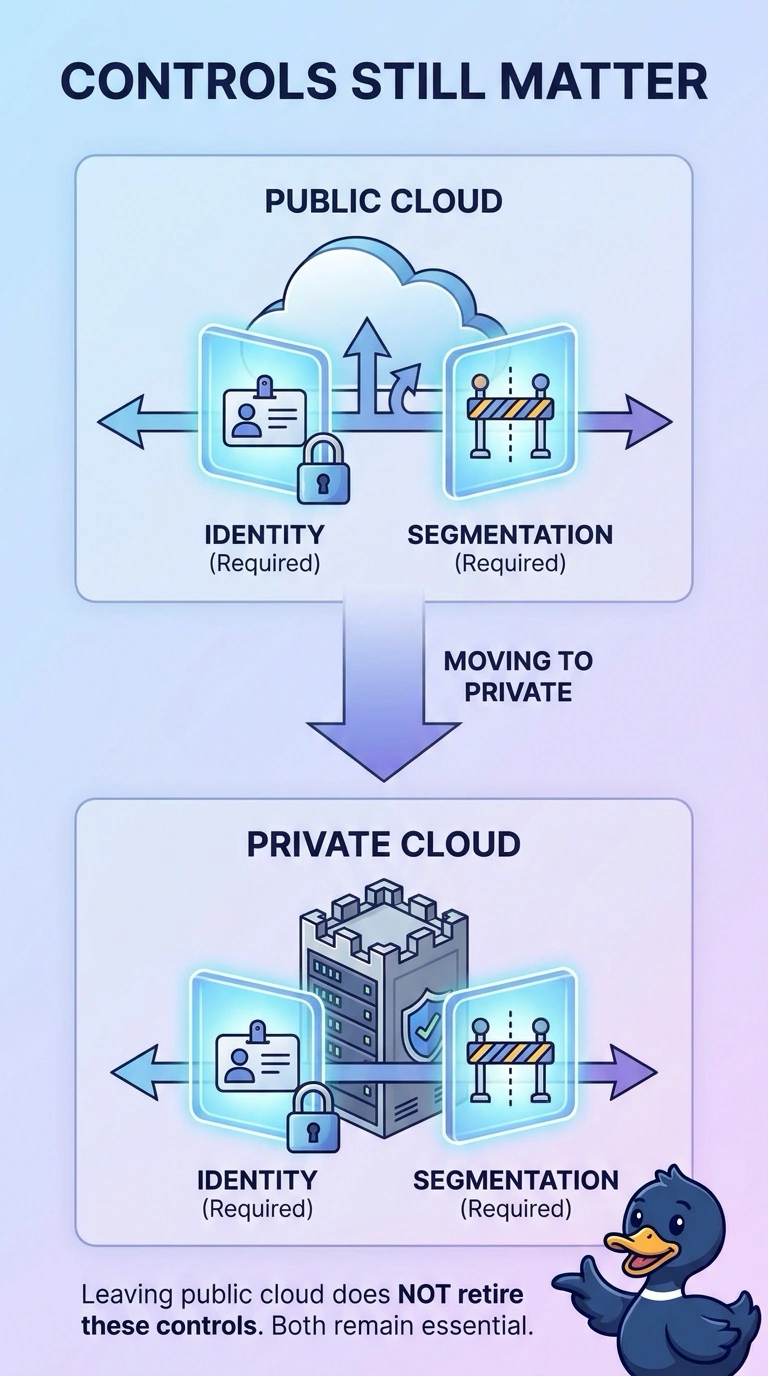
Moving the safe into your own basement does not mean you stop checking who holds the combination. You still need identity and segmentation after the move, because a private cluster is not an open room. The trap is dropping those checks only because the workload left a public cloud.
Full Explanation
A private hypervisor cluster is still a place where callers must be identified and where workloads must be segmented. Private cloud still requires identity and segmentation, and leaving the public cloud does not retire either control. There is a flaw in dropping the checks. Identity checks do not apply only while a workload remains in a public cloud account, because trust is not implied by sitting on an inside network the bank operates. The private cluster port group is not a complete boundary. Removing the segmentation policy because the guests share a port group repeats the mistake of treating a switch grouping as enforcement. Shared responsibility on a public cloud leaves identities and data with the customer, and a move onto the bank's own cluster does not assign sign-in decisions for the guest application to the hypervisor vendor. The bank still decides who may sign in. Exam caveat: private cloud does not erase the need to segment and identify. Operational check: confirm the payments workload still requires an authenticated caller and that an enforced policy, not only the port group, separates it from the rest of the cluster.