
A clinic keeps patient records in on-premises virtualized infrastructure and places those guests in their own port group on a shared virtual switch. Staff tell auditors that the port group is the security boundary between the records and every other guest. What still has to be true for that isolation to hold?
Select an answer to reveal the explanation.
Short Explanation
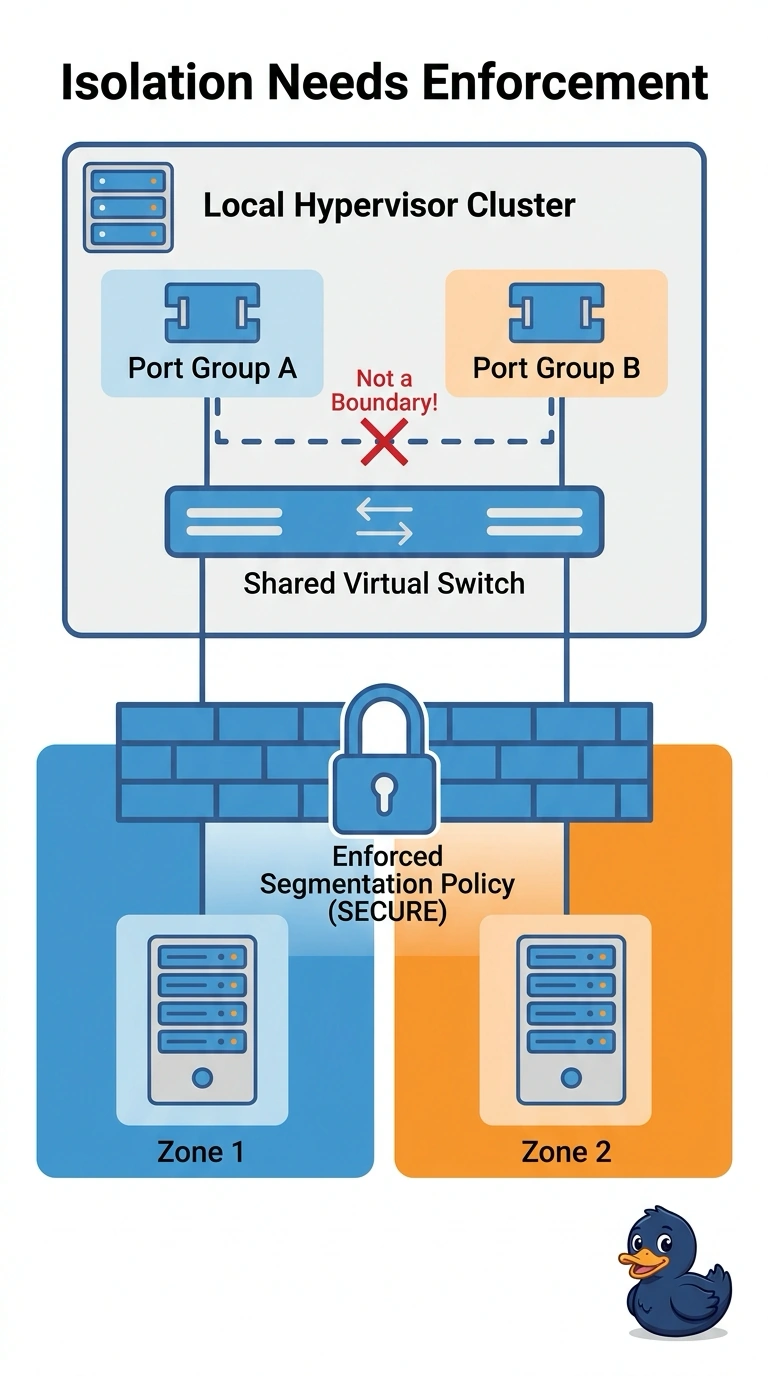
A name tag on a door does not lock the door. You still need a rule that stops the traffic, because a port group is only a label on a shared virtual switch. The trap is treating that label as the boundary.
Full Explanation
A port group name alone establishes no isolation. Confirm the configured VLAN separation and enforce the required policy wherever traffic can cross between groups, so patient-record isolation is the policy, not the group name. The claim that the port group alone isolates the guests treats on-premises virtualized infrastructure as if each virtual switch were a hard boundary, and a shared switch does not provide that isolation. Datastore encryption at rest protects bytes on disk. It does not decide which guests may talk, so it is not a substitute for a rule between port groups. A unique port group name is an administrative label. It does not cause the hypervisor management network to drop guest-to-guest traffic, and the management network is not the path those guests use to reach one another. Exam caveat: on-premises virtualized infrastructure can be a private cloud deployment, and a port group is not a security boundary until policy enforces it. Operational check: review the enforced rules between the records guests and the rest of the cluster and confirm the unwanted conversations are denied, not merely drawn on a diagram.