
A school district platform team places two student applications in different Kubernetes namespaces on a private cluster. The team tells auditors that the namespace alone keeps the applications apart. What is still required before that claim is true?
Select an answer to reveal the explanation.
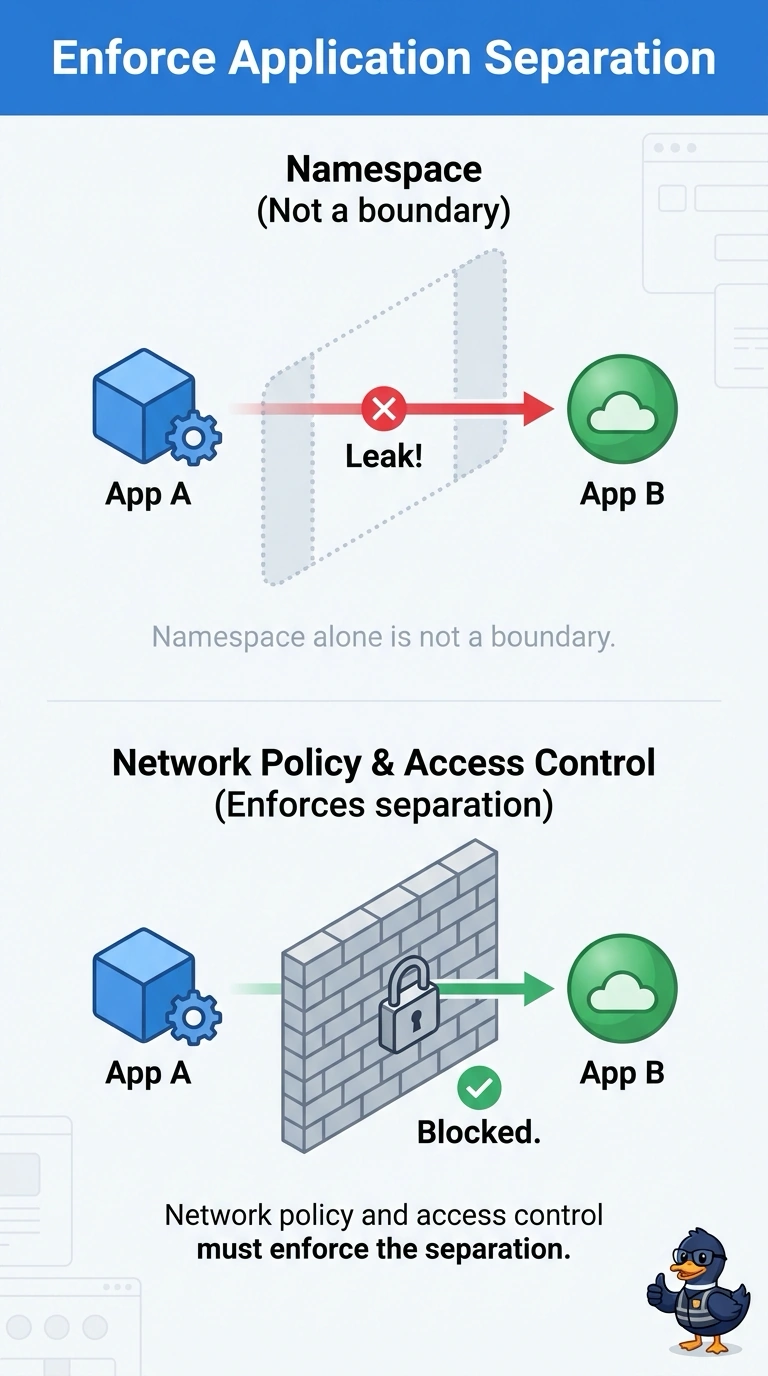
Short Explanation
Two apartments with different numbers on one hallway are not separate until the doors actually lock. You still need network policy and access control, because a Kubernetes namespace is only a label until something enforces it. The trap is showing auditors the namespace and calling the job finished.
Full Explanation
A namespace groups names and objects. It does not keep two applications apart until network policy and access control enforce the separation. Without that enforcement, pods in different namespaces can still be reachable if the cluster allows it. Nothing further is required is the wrong conclusion, because a Kubernetes namespace is not a security boundary even when someone describes it as one, and the absence of an enforced policy leaves the claim unfinished. A security group copied from a second public cloud limits tiers inside the cloud where it was written. It does not apply by itself inside this private cluster. Last year's architecture PDF is a document. It is not a current enforcement control, and a picture of the intended design does not drop packets. Exam caveat: a Kubernetes namespace scopes names and objects. Enforce network policy and access controls to isolate the workloads. Operational check: attempt a connection between the two applications that policy should deny, and confirm the packet is dropped by an enforced network policy rather than merely discouraged by the namespace name.