
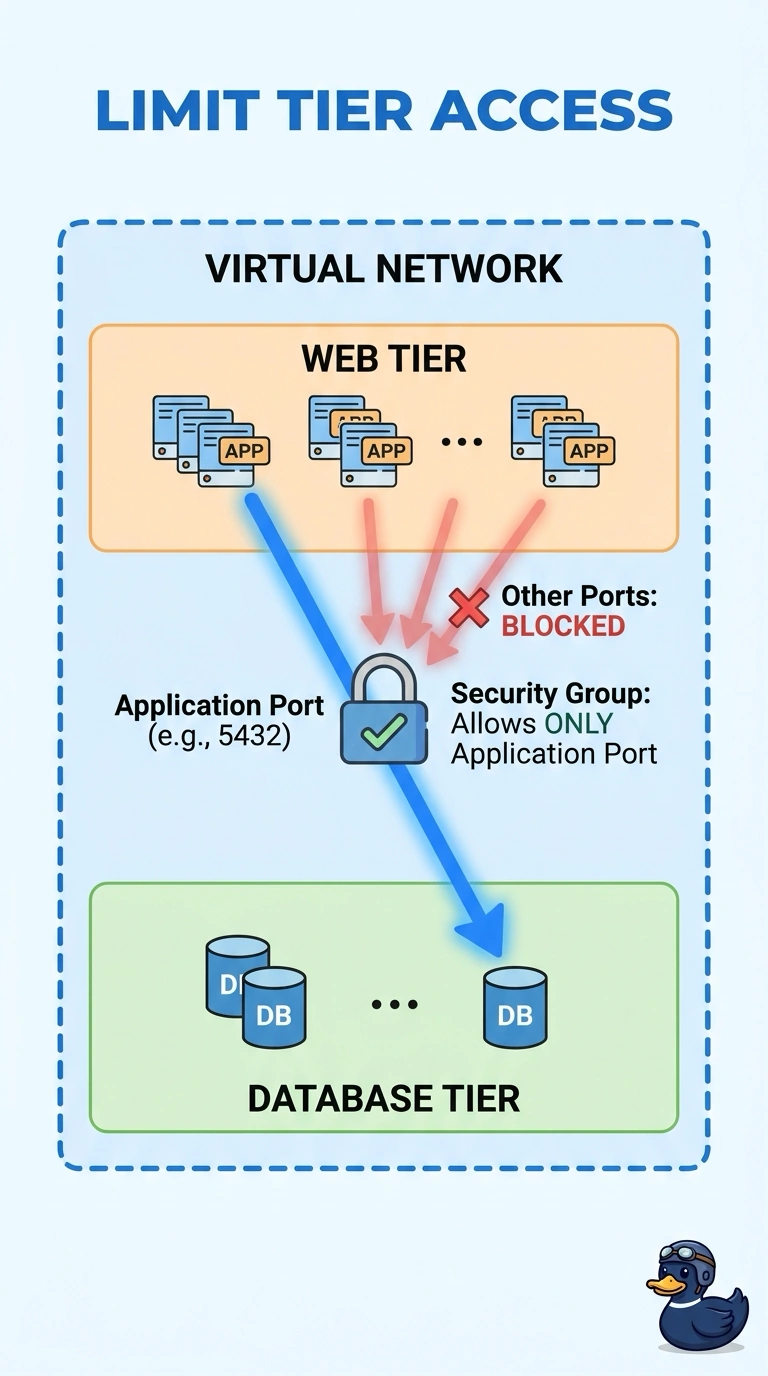
Inside one clinic virtual network, the web tier can reach the database tier on every port. Only the application port should be permitted between those two tiers. Which change enforces that limit?
Select an answer to reveal the explanation.
Short Explanation
Two rooms on one hallway still need a door that opens only for the cart you expect. You use security groups so only the application port is allowed between those tiers. The trap is an any-to-any opening, disk encryption, or a new login that never closes a port.
Full Explanation
Security groups are how you limit tiers that share one cloud network. Here the web tier should reach the database tier only on the application port, so the group should allow that port and not the rest. Sharing a virtual network does not make every port acceptable. Customer-managed encryption of the database disks protects stored bytes. It does not close listening ports, and it does not decide which tier can connect. Federation of the database administrator credential replaces a standing key for an identity. It removes no open port and it is not a substitute for a security group change. One any-to-any allow between the tiers is the condition the clinic already has, and security groups can limit ports inside a single virtual network. Exam caveat: a security group in this network does not automatically enforce itself in a second cloud, but this problem is inside one network. Operational check: from a web-tier host, attempt the application port and a second port, and confirm only the application port succeeds.