
Months after a project ended, a contractor at a construction firm still holds a standing owner role on the cloud subscription. Which access model should replace it?
Select an answer to reveal the explanation.
Short Explanation
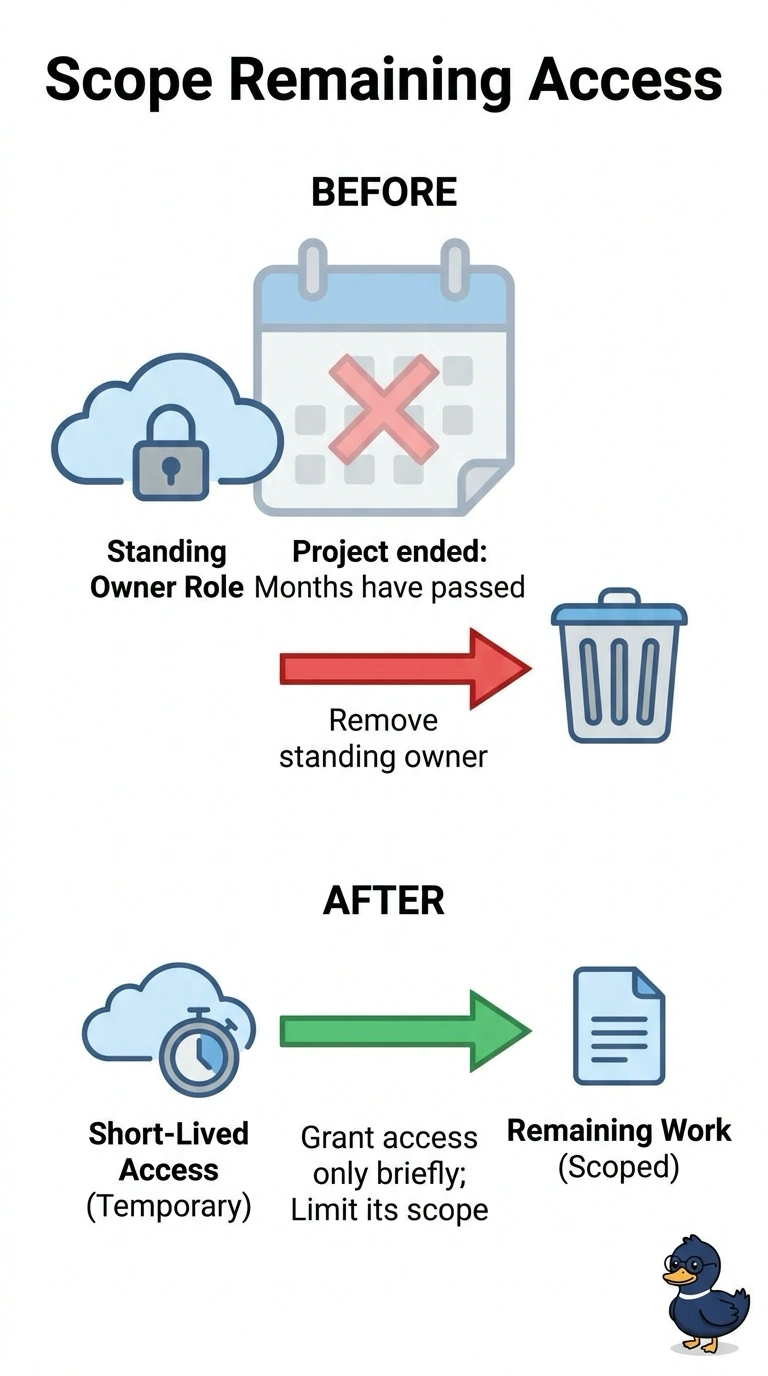
A master key left on the ring after the contractor goes home still opens every door. You replace that standing owner role with short-lived access scoped to whatever work remains. A second long-lived key in the pipeline, or a one-time posture write-up, keeps the standing privilege in spirit.
Full Explanation
A standing owner role months after the project is the opposite of least standing privilege. Short-lived, scoped access beats a standing owner key, so you replace the standing owner role with short-lived access that is scoped only to the work still left on the project. The choice to leave the standing owner role in place and check a second long-lived owner key into the firm's build pipeline adds another long-lived secret, and a long-lived key checked into a pipeline is what federation and short-lived access are meant to retire. The choice to add a security group in this cloud and expect that group to enforce the same boundary inside the firm's other public cloud confuses a network rule in one cloud with identity, and a security group does not travel to a second cloud by itself. The choice to archive the original posture report and treat that one-time document as the ongoing control on the contractor confuses a point-in-time configuration finding with access, and posture is not a one-time document that keeps working. Exam caveat: for an infrastructure subscription the customer still owns identities and the rights those identities hold, even when the provider runs the platform underneath. Operational check: confirm the contractor's standing owner assignment is gone and that any remaining access is short-lived and scoped to the leftover task.