
A warehouse security architect lists the stages Traditional, Initial, Advanced, and Optimal, then tells leadership that this scale comes from NIST SP 800-207. Which document actually defines those stages?
Select an answer to reveal the explanation.
Short Explanation
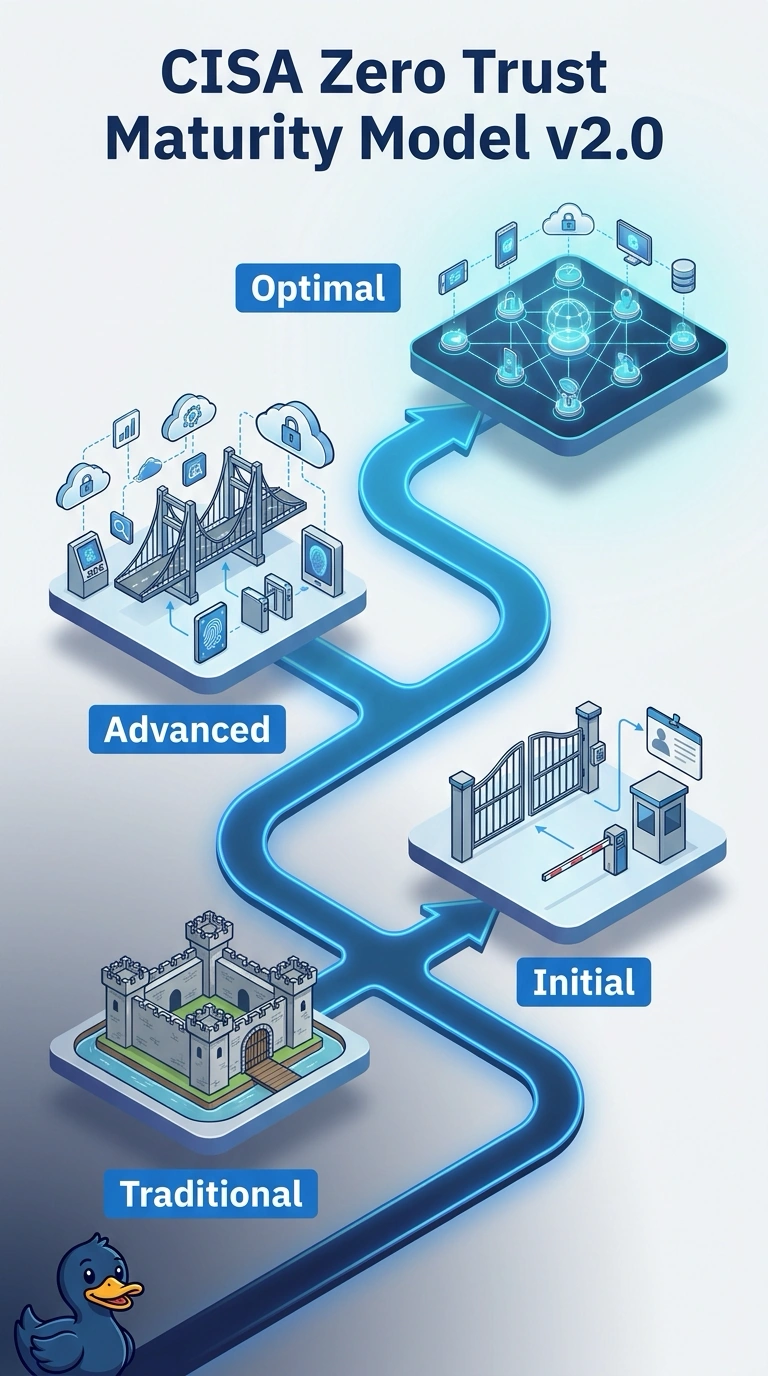
Think of a ruler and a floor plan that both describe a building while only one carries the inch marks. When you hear Traditional, Initial, Advanced, and Optimal, you are looking at the CISA maturity scale, while NIST SP 800-207 describes a decision point and an enforcement point. The trap is treating those stage names as if they came from the NIST document.
Full Explanation
The stage names Traditional, Initial, Advanced, and Optimal are the maturity scale in the CISA Zero Trust Maturity Model v2.0. That model organizes progress across pillars such as Identity, Devices, Networks, Applications and Workloads, and Data, plus cross-cutting capabilities such as Visibility and Analytics, Automation and Orchestration, and Governance. Traditional still trusts the campus interior. NIST SP 800-207 is a different document: it describes an architecture in which each request to a specific resource is verified, a policy decision point decides, and a policy enforcement point carries the decision out. Trust is not implied by sitting on the inside network. Citing NIST SP 800-207 as the source of the four stages swaps the architecture for the maturity scale. A campus interior trust model, which treats a device on the warehouse LAN as trusted without a per-request decision, is the habit the maturity scale calls Traditional, and it is not the publication that names the stages. A shared-responsibility matrix, which assigns the cloud platform to the provider and identities and data to the customer, explains a cloud duty split and does not define this scale. Exam caveat: the two publications often appear in the same design review, and they are not interchangeable. Operational check: when a slide lists those four stages, label it as the CISA Zero Trust Maturity Model v2.0 and keep policy decision point and policy enforcement point language with NIST SP 800-207.