
A utility still trusts every host that sits on the campus network and controls access only with static perimeter access lists. Where does that design sit on the CISA Zero Trust Maturity Model scale?
Select an answer to reveal the explanation.
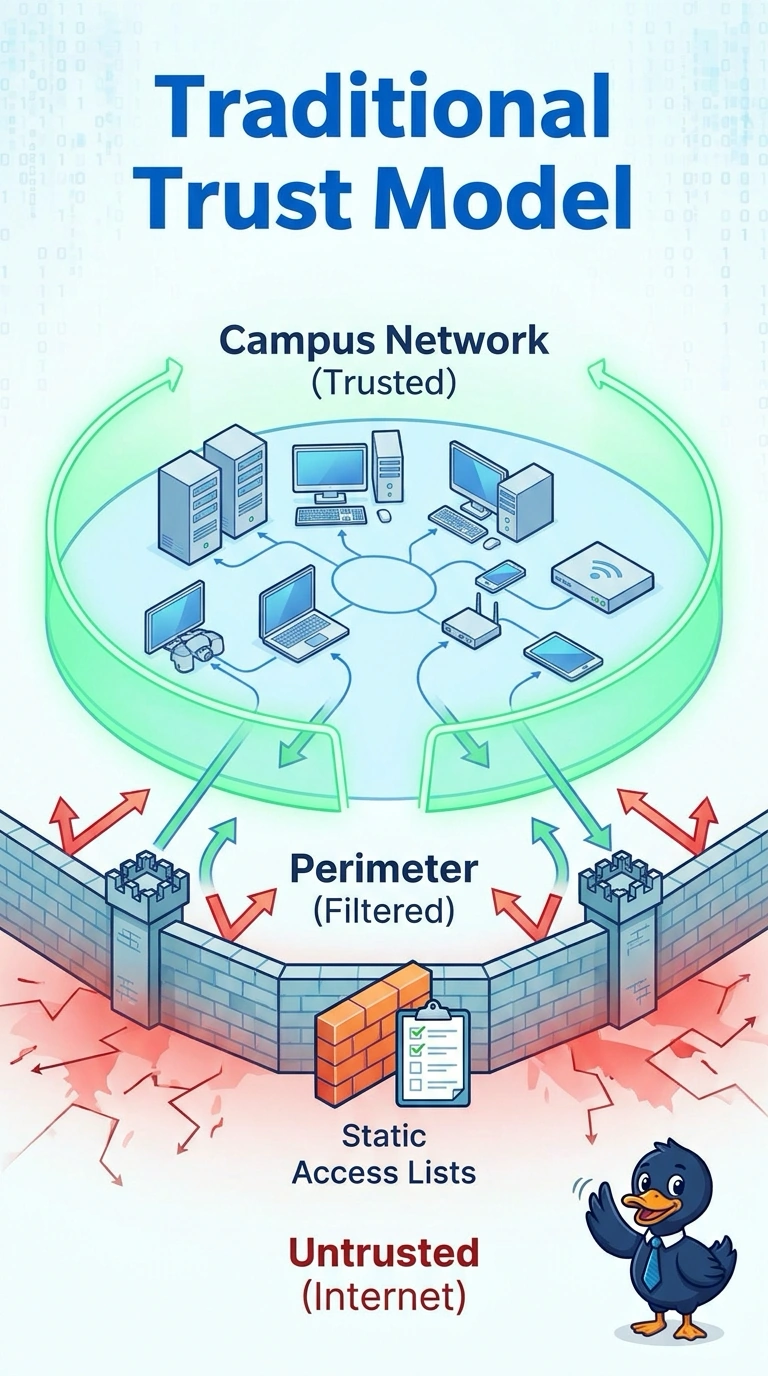
Short Explanation
Think of a castle that checks people at the outer gate and then lets everyone inside wander the halls. You call this design Traditional, because the campus interior is still trusted and only the perimeter is filtered. The trap is hearing the words access list and promoting the network to Advanced, Initial, or Optimal.
Full Explanation
The CISA Zero Trust Maturity Model v2.0 uses the stages Traditional, Initial, Advanced, and Optimal. Traditional still trusts the campus interior. A utility that trusts every host on the campus and filters only with static perimeter lists is Traditional, because the campus interior is still trusted and only the perimeter is filtered by static lists. Optimal is the far end of that scale, and static access lists do not already verify each request to one specific internal resource. Advanced is not a fair label either, because a perimeter list is not the same control as continuous identity-based access per resource. Initial is the stage after Traditional, and publishing any access list does not mean the network has already left the traditional stage. Exam caveat: those four stage names belong to the CISA maturity model, and they are not the architecture description in NIST SP 800-207. Operational check: ask whether a host is trusted merely because it sits on the campus, and if the answer is yes, keep the design at Traditional until per-request decisions exist.