
A hospital security lead wants to purchase a single gateway, label the campus zero trust, and then trust every device that has passed that box. During the design review, the board asks what must happen on each request for a resource. Which description matches that requirement?
Select an answer to reveal the explanation.
Short Explanation
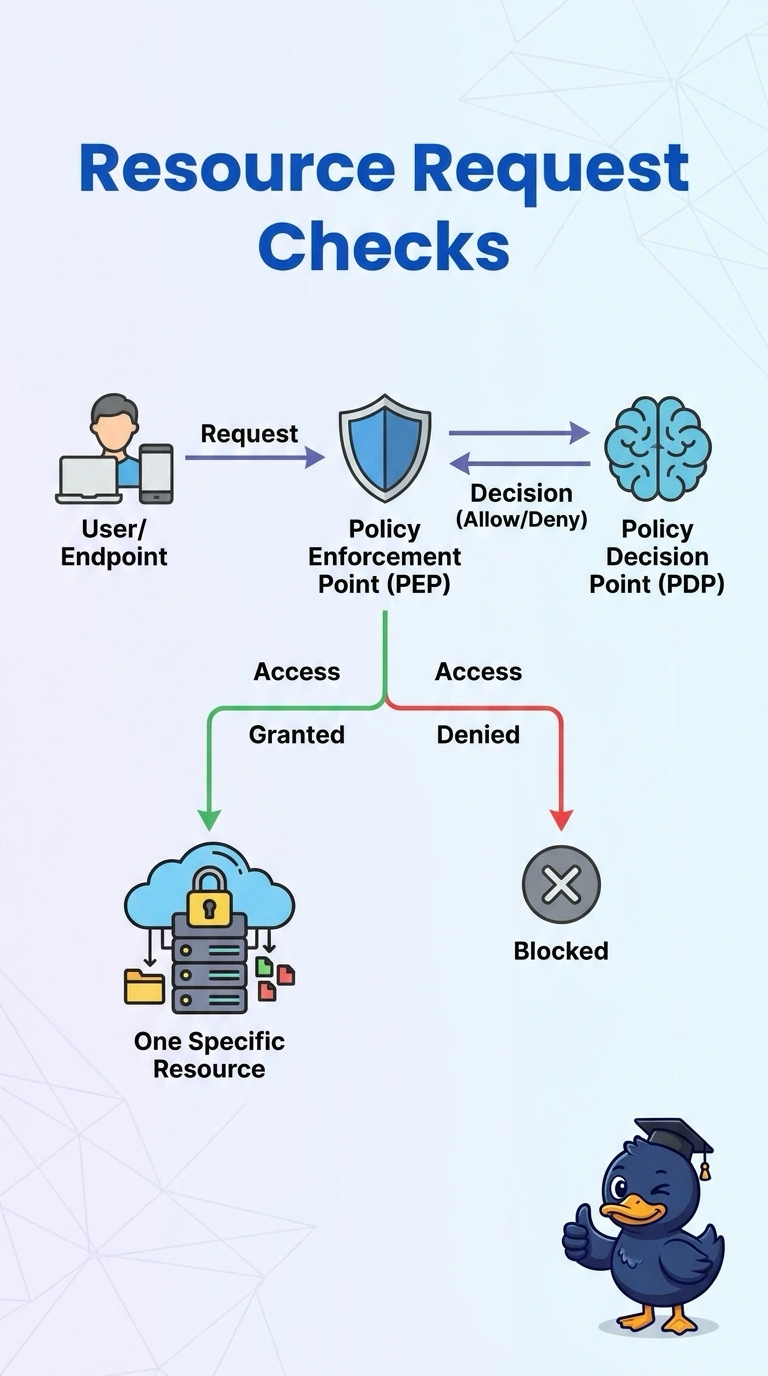
A lobby badge does not hand you a key to every room upstairs. You still verify each request for one specific resource, with a point that decides and a point that enforces. Buying one appliance and then trusting the campus interior skips that split.
Full Explanation
NIST SP 800-207 describes zero trust as a check on each request to a specific resource, not as trust earned by sitting on the inside network. NIST calls for per-session access to individual resources, dynamic policy, and continued reevaluation as warranted. The policy decision point decides and the policy enforcement point applies that decision, including when the device already passed a front gateway. Buying one appliance so you can trust the campus interior after the first login, and then treating that purchase as the whole zero trust program, recreates a perimeter: the first success becomes a standing pass. Renaming the current perimeter firewall project and keeping trust for any host already on the internal network changes a label and leaves location-based trust in place. Treating internal VLAN membership as sufficient proof to open every clinical system still grants a segment rather than one resource. On the exam, a new box described as zero trust is still the wrong architecture when the interior of the network is doing the trusting. In operations, take one request for a single clinical application from a device already on the hospital network and confirm a fresh decision is made for that resource and enforced on the access path.