
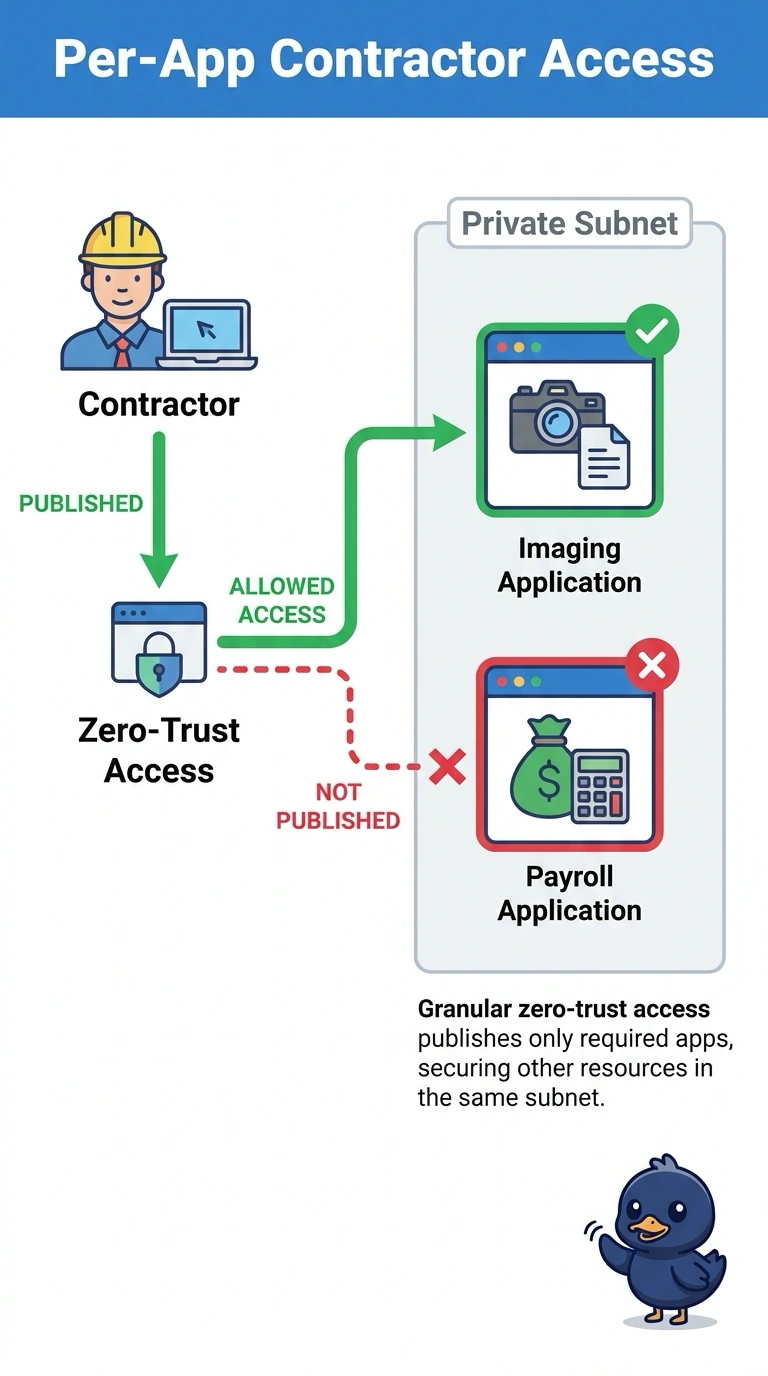
A clinic contractor may open the imaging application and must be denied the payroll application, even though both applications sit on the same private subnet. Which design matches that split?
Select an answer to reveal the explanation.
Short Explanation
A key to one office is not a key to the whole floor. You publish imaging and withhold payroll with per-application access even when both sit on the same subnet. A subnet tunnel that includes both applications lets the contractor try payroll.
Full Explanation
Zero-trust access can publish one application and withhold another, even when both addresses sit on the same subnet. Per-application zero-trust access that publishes the imaging application and does not publish the payroll application gives the contractor the allowed application only. A subnet tunnel that includes the whole private subnet places the contractor on a path that can reach every host in that subnet, including payroll. A verbal instruction not to open payroll is not an enforcement point. A DNS block on the imaging name would stop the application the contractor is allowed to use. It does not remove payroll from the subnet, and a client with a hardcoded address would skip the block. A ThousandEyes test to the imaging host reports path experience. A successful path does not grant imaging, and it does not withhold payroll. Exam caveat: publishing imaging by name still requires the contractor identity to be allowed on that application, or the right design denies both. Operational check: sign in as the contractor, open imaging, and confirm payroll has no published access and is not reachable through a subnet route.