
A community hospital will not grant private application access until disk encryption on the laptop is confirmed. Staff currently reach those applications only through a browser. Which check can see the encryption state?
Select an answer to reveal the explanation.
Short Explanation
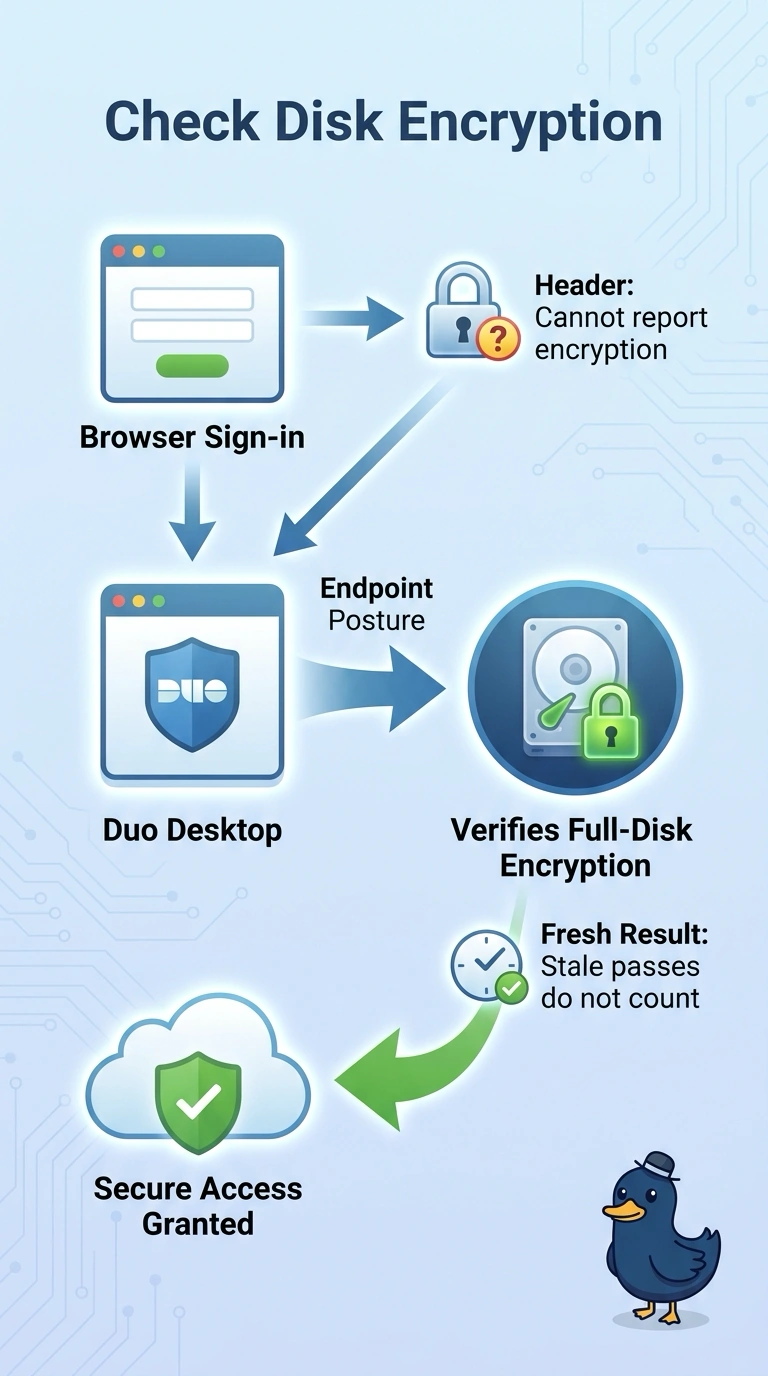
Asking a visitor what color the bolt is does not prove the door is locked. You require endpoint posture that can verify disk encryption, such as Duo Desktop with a Duo Desktop policy, because a browser header cannot report it. A pass from last quarter is already stale for today's session.
Full Explanation
A disk-encryption check needs a posture solution that can see the laptop. Duo Desktop with a Duo Desktop policy in the browser authentication flow can verify full-disk encryption, and a clientless browser header cannot, so the hospital should require endpoint posture before private access. Secure Client is not the only native posture solution, but the check must come from software on the endpoint. Trusting the browser header sent during clientless access overstates what a browser presents. That header does not report disk encryption or whether the laptop is managed. Accepting a posture result from last quarter reuses a stale pass. It does not prove the disk is encrypted for today's private session. Using a ThousandEyes path test to the security service edge measures reachability. A healthy path does not confirm the laptop disk is encrypted, and path evidence does not grant private access. Exam caveat: a posture failure should change authorization when policy says noncompliant devices are denied, rather than being logged and then ignored. Operational check: attempt private access from a laptop with encryption disabled and confirm the posture result denies it, then repeat from an encrypted managed laptop and confirm access is allowed.