
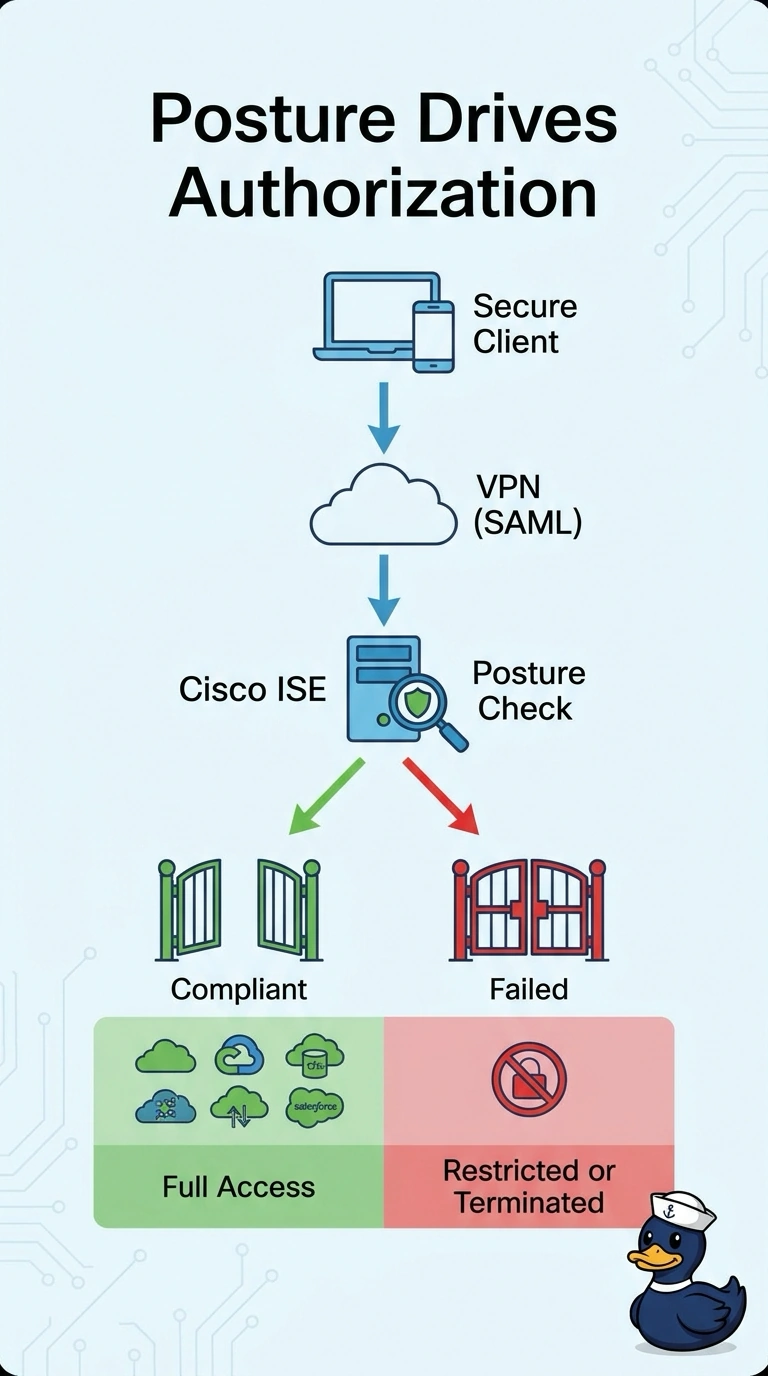
An airline crew laptop completes RADIUS authentication to VPN as a service. The profile uses Cisco ISE for authorization and Change of Authorization, and this laptop fails its Secure Client posture check. What is true of the access decision?
Select an answer to reveal the explanation.
Short Explanation
Showing an ID at the desk is not the same as passing the health screen at the gate. RADIUS authentication proved who the crew member is, and you still apply the authorization ISE returns for the failed posture check. That result can restrict or terminate access according to policy.
Full Explanation
RADIUS authentication confirms the crew member's credentials for VPN as a service. Authorization is a second gate. Cisco ISE acts as the RADIUS server and, with Change of Authorization, can change the session's access when the Secure Client posture result arrives. For a failed posture check, the correct action is to apply the authorization that ISE returns, which can restrict or terminate access according to policy. Treating the successful authentication as the authorization result collapses those gates. Replacing the posture result with a ThousandEyes path test swaps a health decision for a path measurement. A reachable edge does not prove the laptop meets the health check, and path evidence does not grant the session. Applying a DNS policy on the airline resolver affects name lookup for clients that use that resolver. It is not the object ISE returns after RADIUS authentication, and it does not encode posture. Exam caveat: a completed sign-in can appear before ISE has applied the posture outcome through Change of Authorization, so the login is not the final allow. Operational check: read the ISE authorization result for this laptop and confirm it matches the failed posture result rather than the full-access result used for healthy devices.