
A physician at a hospital opens a clientless browser bookmark to an HTTP private application and never starts Cisco Secure Client. A reviewer says the session is invalid unless it uses MASQUE. Which statement is accurate?
Select an answer to reveal the explanation.
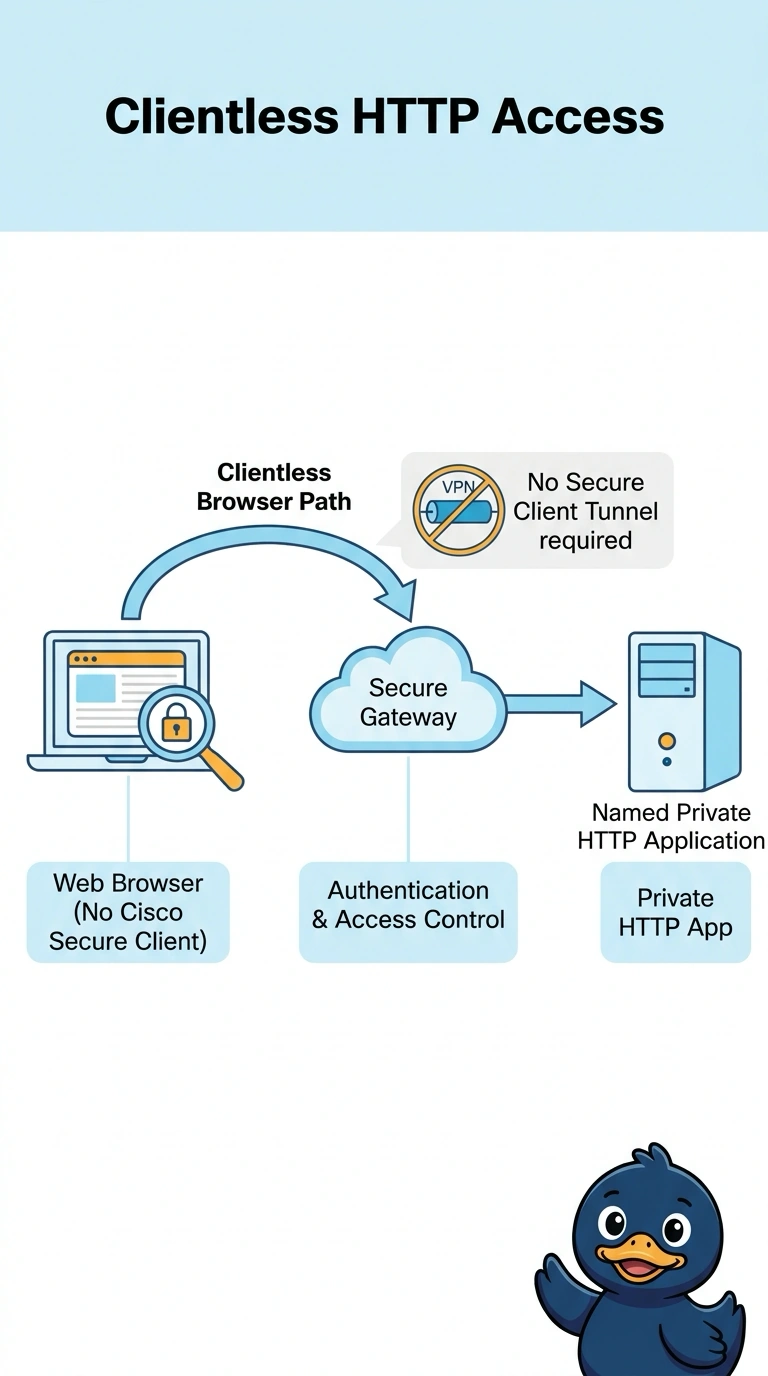
Short Explanation
Walking through a lobby to one office is not the same as driving a private tunnel into the building. You are on a clientless HTTP bookmark, and that path does not use the client transport. The trap is demanding a tunnel the browser session never starts.
Full Explanation
Clientless zero-trust access is a browser path for HTTP and HTTPS. It reaches the named application without placing the user on the network, and it does not use the client transport. The clientless browser path to the named private HTTP application needs no Secure Client tunnel, so the browser bookmark does not have to negotiate a client transport such as MASQUE before the first HTTP request. That belongs to the client-based path the physician never started. Clientless access does not place the physician on the server subnet. Because the user is not on that network, there are no neighboring addresses to hide. VPN as a service is the full private-access method for applications zero-trust access cannot carry. It is not the only way to open an HTTP bookmark, and it is not the path this clientless session uses. Exam caveat: client-based access uses Secure Client, and the clientless browser path is a different method. Operational check: confirm the physician's session is recorded as clientless access to the named HTTP application and that no Secure Client tunnel was required for it.