
A bank requires every VPN as a service login to be checked by Cisco ISE, and requires ISE to return the authorization result. A technician wants each laptop to approve itself from a local account. Which configuration meets the bank's requirement?
Select an answer to reveal the explanation.
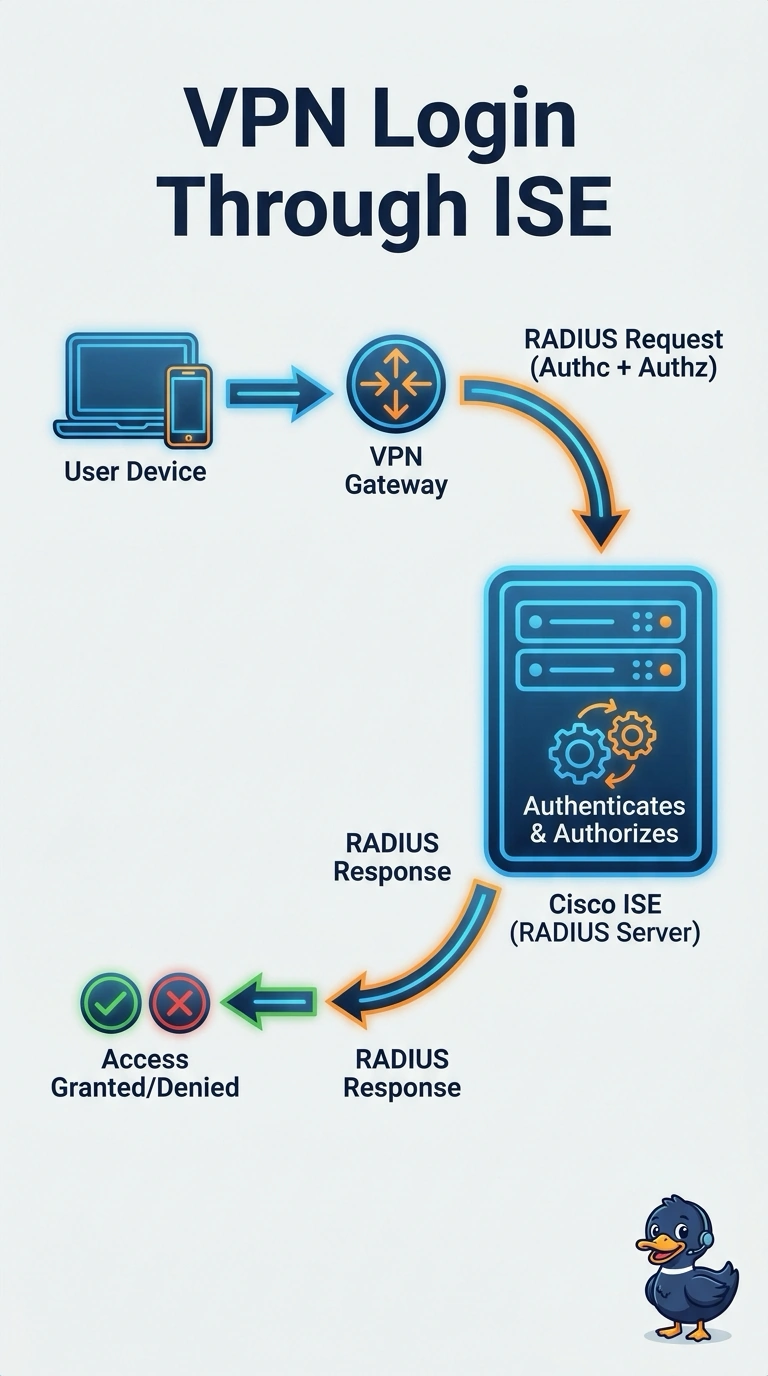
Short Explanation
The person at the door has to hold the list, not a note in the visitor's pocket. You point the VPN service at ISE so ISE checks the login and returns the authorization. A password that lives only on the laptop never makes that check.
Full Explanation
Point the VPN service at ISE as the RADIUS server so authentication and authorization both happen there, rather than on a store kept on the endpoint. Approving each login from a local account on the laptop never asks ISE for a decision, and a password kept only on the device is not the bank's authorization source. A ThousandEyes path test shows experience and path evidence. It does not decide authorization, and skipping ISE when the path looks healthy replaces the RADIUS check with a connectivity measurement. A compliant Secure Client posture result describes device health. Posture can change what ISE returns when policy says so, but it is not itself a successful login when no credential is checked. Exam caveat: ISE is the authentication and authorization point for this VPN service, and a green path test does not stand in for RADIUS. Operational check: attempt a login and confirm the VPN service sends a RADIUS request to ISE and that the accept or reject returned by ISE is what the session follows.