
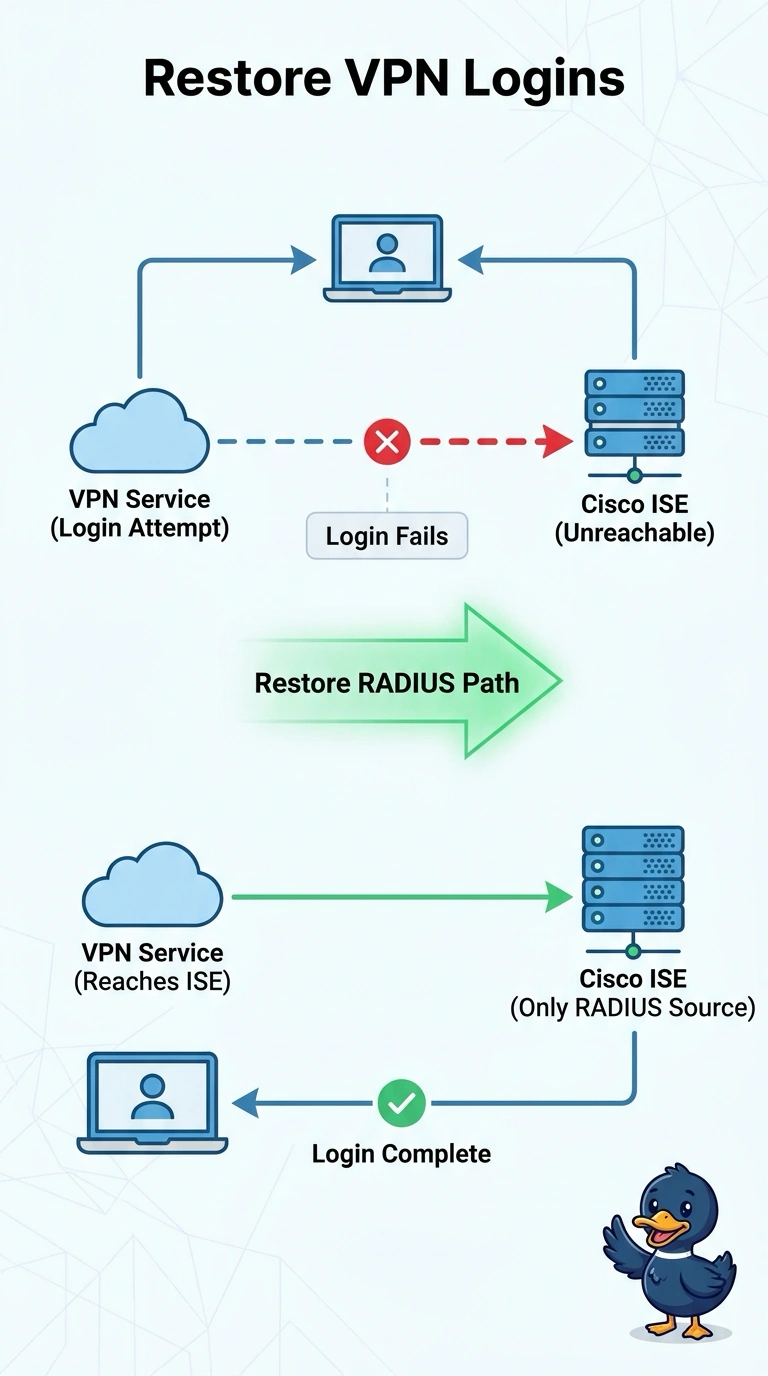
A hospital uses Cisco ISE as the only RADIUS source for VPN as a service. ISE cannot be reached, and every login fails. Which action restores those logins?
Select an answer to reveal the explanation.
Short Explanation
If the only locksmith is away, cutting a key at home does not open the shop. You restore the path to ISE, because that is the only RADIUS source and logins fail while it is unreachable. Changing how a laptop searches names does not bring RADIUS back.
Full Explanation
When ISE is the only RADIUS source, the VPN service cannot authenticate or authorize anyone while that server is unreachable. Logins return when you restore the RADIUS path so the VPN service can reach Cisco ISE and complete the exchange. Changing the DNS search list on each client fixes a suffix used for name lookups. A search list is not a RADIUS path, and successful name resolution does not make an unreachable policy server answer authentication. Disabling Secure Client posture checks removes a health input ISE might use after a user is identified. A posture probe is not the keepalive for RADIUS, and turning it off does not create a route to ISE. A clientless browser bookmark is an HTTP entry to a private application. It does not answer RADIUS requests, and publishing one does not give the VPN service a policy server. Exam caveat: path quality and name lookup are separate from RADIUS reachability. Operational check: from the VPN service, confirm packets to ISE succeed, then complete a test login and verify ISE records the accept or reject.