
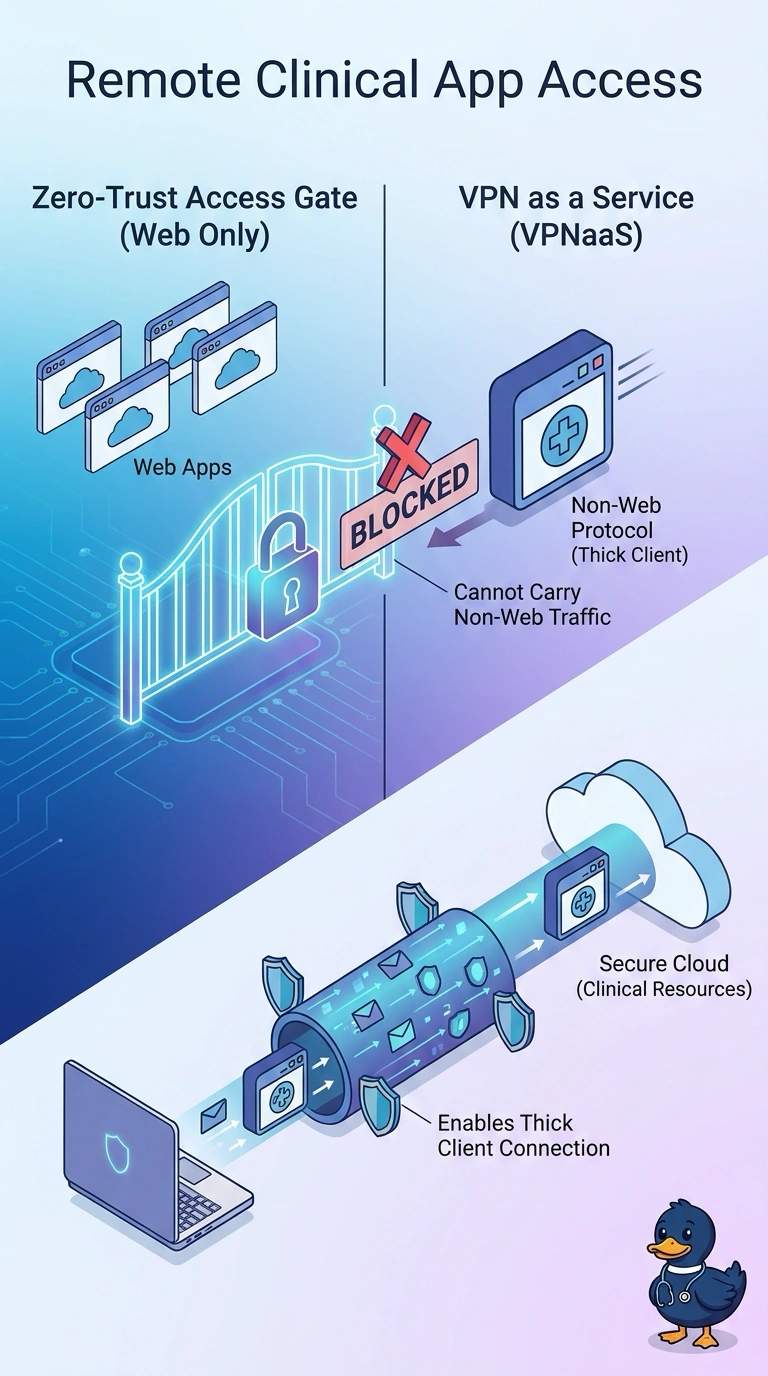
A hospital clinical thick client uses a non-web protocol that zero-trust access cannot carry, and it cannot be published as a web application. Which method can still give clinicians that application from outside?
Select an answer to reveal the explanation.
Short Explanation
A piano will not fit through a browser window, so you send it on the freight elevator. You use VPN as a service because this non-web thick client uses a protocol that zero-trust access cannot carry. Clientless browser access cannot publish that client as a web application.
Full Explanation
VPN as a service is the private-access method for applications and non-web traffic that zero-trust access cannot carry. This clinical thick client uses a non-web protocol and cannot be published as a web application, so VPN as a service can still give clinicians the application from outside the hospital. Clientless zero-trust access provides a browser path for HTTP and HTTPS; a browser session cannot carry a thick client that is not an HTTP application. A public address plus a hosts-file override exposes the client on the internet but does not turn its non-web protocol into a private web app. Client-based zero-trust access remains zero-trust access, and limiting it to a browser bookmark describes a web session, not a way to carry this thick client. Exam caveat: client-based zero-trust access with MASQUE over QUIC or TLS can fit per-application TCP and UDP traffic that zero-trust access supports, but it does not replace VPN as a service when the application is outside that supported scope. Practical check: connect through VPN as a service from outside the hospital and confirm that the thick client opens; then confirm that a browser-only session to the same name does not.