
A managed hotel employee needs per-application TCP access with Cisco Secure Client and must not receive a subnet on a virtual adapter. Which access method matches that requirement?
Select an answer to reveal the explanation.
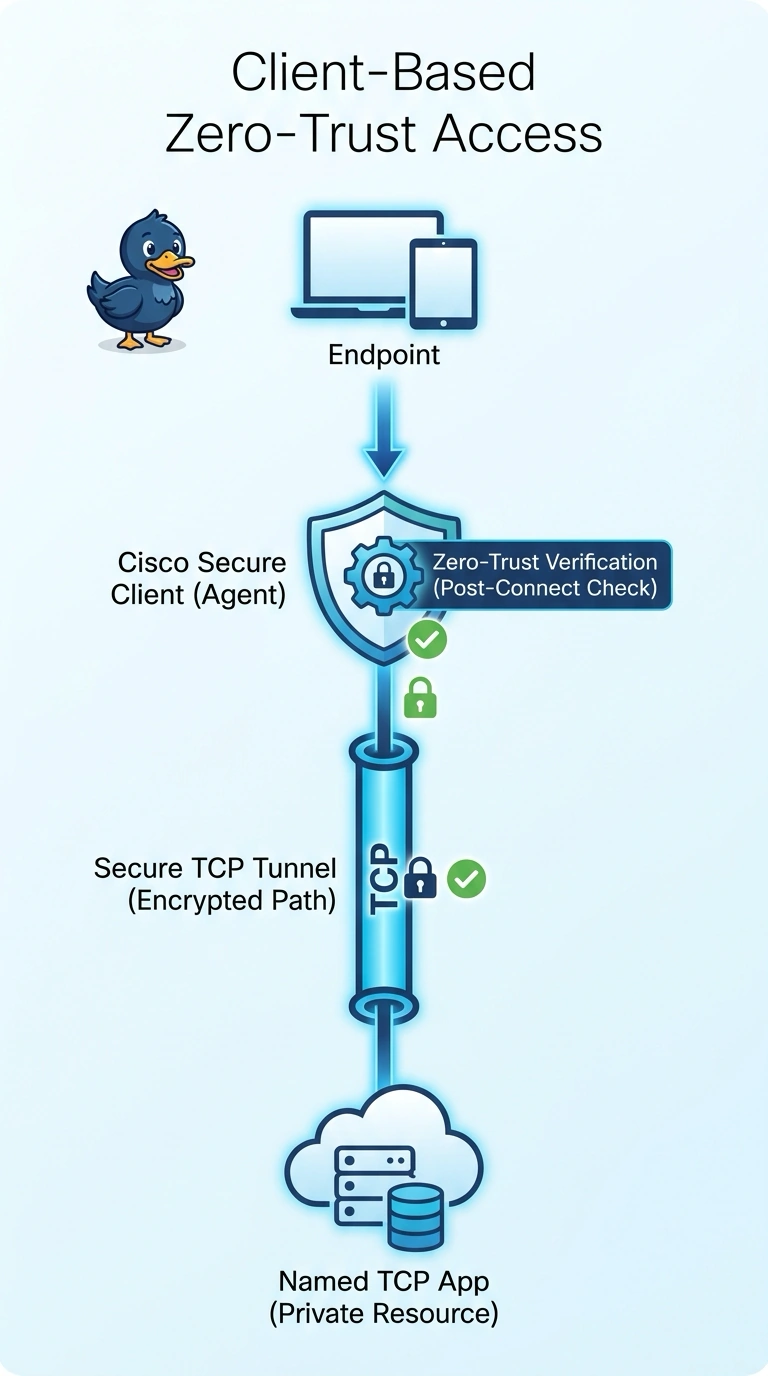
Short Explanation
A reserved seat on one train is not the same thing as owning the whole rail line. You use client-based zero-trust access through Cisco Secure Client, so Secure Client reaches the application without a subnet on the adapter. A full tunnel or a browser-only path answers a different request.
Full Explanation
Secure Client supports client-based zero-trust access for supported TCP and UDP applications, with authorization scoped to the configured private resource rather than a subnet. That is the fit for a managed employee who needs per-application TCP access and must not receive a subnet on a virtual adapter. Clientless zero-trust access is a browser path for HTTP and HTTPS. A browser does not reach every TCP application, and this requirement specifically calls for Secure Client. VPN as a service can carry applications zero-trust access cannot, but placing the employee on the private subnet is the full private-network outcome this requirement excludes, and TCP access does not by itself require that full tunnel. A network tunnel group that statically routes the remote-access pools is the branch IPsec path, including those pools in the static routes. It is not per-application access for one employee, and it does not replace Secure Client for this user-based requirement. Exam caveat: client-based zero-trust access through Cisco Secure Client covers the named TCP application. VPN as a service is the method for an application zero-trust access cannot carry, which is a different request than per-application TCP with Secure Client. Operational check: connect with Secure Client, open only the named TCP application, and confirm the adapter does not receive a subnet route into the hotel network.