
A contractor uses an unmanaged laptop at a research lab, needs only one web application, and must not be placed on the lab network. Which access method fits that constraint?
Select an answer to reveal the explanation.
Short Explanation
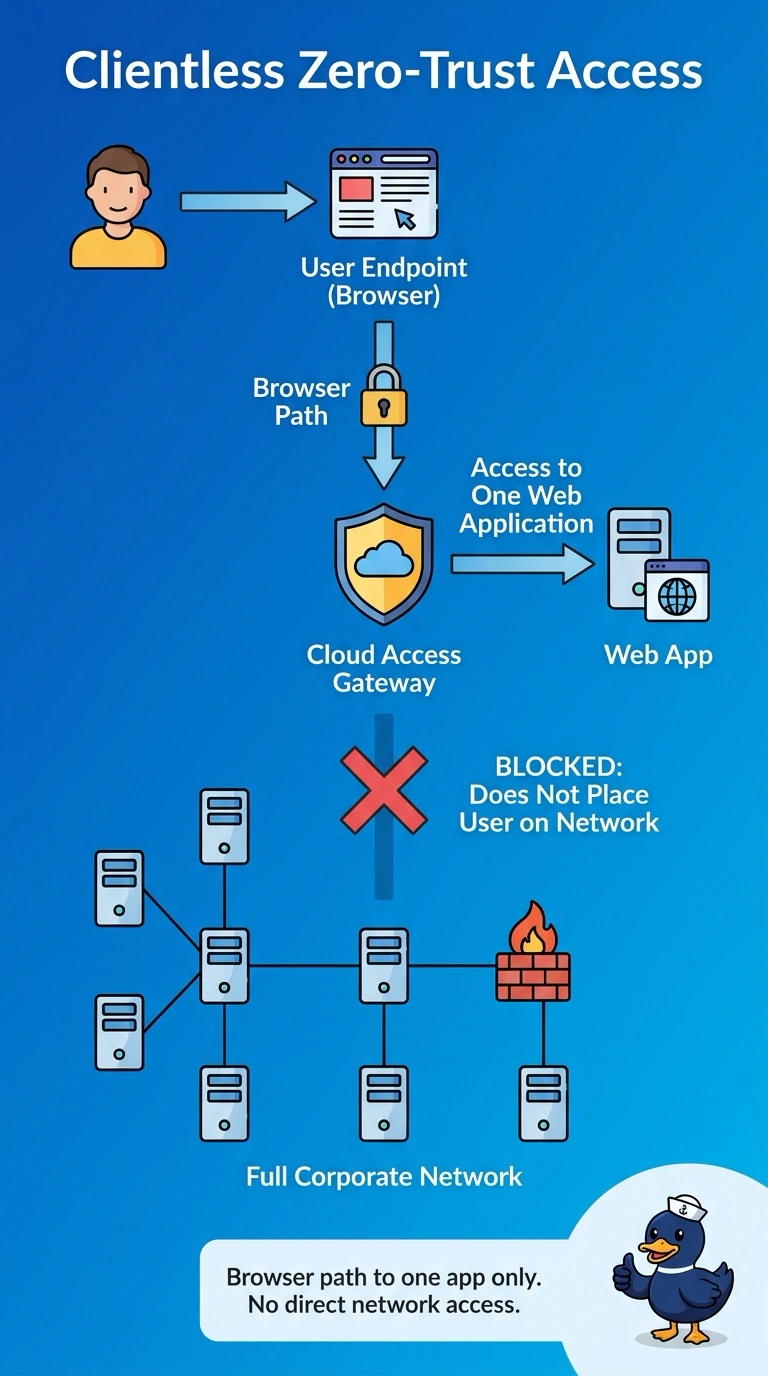
A visitor pass for one conference room is the right tool when a master key to the whole building is more than the visit requires. You give the contractor clientless zero-trust access, a browser path to that one web application that does not place the laptop on the network. A full tunnel hands over the building.
Full Explanation
Clientless zero-trust access is a browser path for HTTP and HTTPS, with a per-application name, and it does not place the user on the network. That matches a contractor on an unmanaged laptop who needs one web application and must not land on the lab network. VPN as a service with a full tunnel is the method for applications zero-trust access cannot carry, and it places the user on the private network, which is more access than this web application requires. Client-based zero-trust access uses Secure Client for broader TCP and UDP application access and is still per application rather than per subnet. It does not place a subnet on the adapter, so that description is the wrong tool and the wrong picture of how client-based access works. A resource connector is a virtual machine inside the network that exposes private resources. It is not a user client installed on the contractor laptop. Exam caveat: the browser has to be the path the contractor actually uses. A laptop that is not in that browser session does not get the application, and it also does not get a route onto the lab network. Operational check: open the web application from the unmanaged laptop in the browser, confirm the session is the named application, and confirm the laptop has no address on the lab network.