
IKE shows that a factory network tunnel is up, yet users still cannot reach a private quality application because the return route inside the site is missing. What should be fixed?
Select an answer to reveal the explanation.
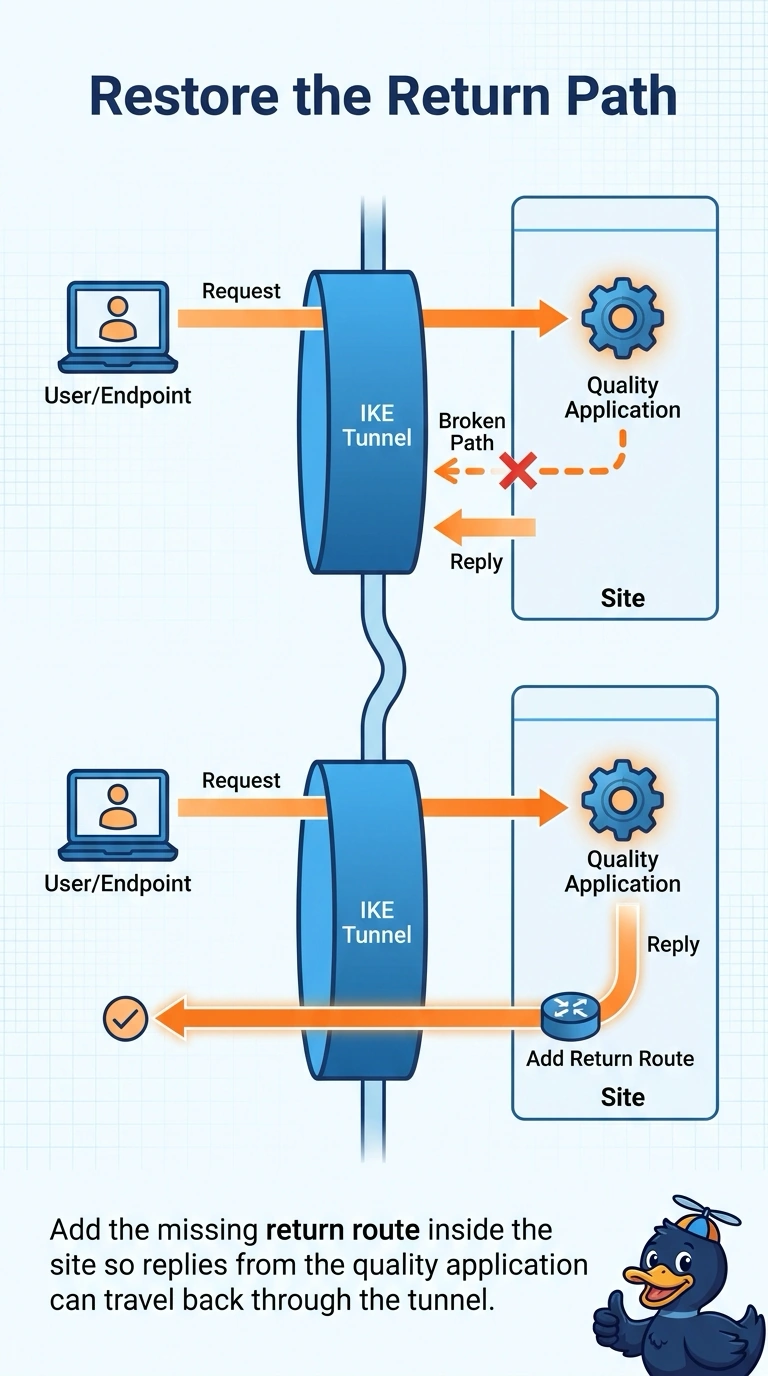
Short Explanation
An open highway on-ramp does not help if the street back to the plant is closed. You can add the missing return route inside the site so replies from the quality application travel back through the tunnel. IKE showing the tunnel up confirms negotiation, not that the internal path works.
Full Explanation
An IPsec tunnel using IKEv2 still needs routing for private traffic to complete its path. IKE showing the tunnel up confirms negotiation, not reachability inside the factory; without the return route, replies from the quality application cannot find their way back through the tunnel. Add that missing route inside the site. Tearing down the tunnel and publishing the application with a public port forward discards a working IKE session and exposes the application; an up IKE session does not prove the internal path. Opening UDP 500 and 4500 on the quality application itself puts tunnel-negotiation ports on an internal host, although those ports belong to the tunnel path, not every server behind it—and the tunnel is already up. Moving the application behind a resource connector while leaving the route missing does not fix the return path for users relying on this tunnel; a connector does not remove the need for routing on that path. Exam caveat: overlapping addresses are handled by naming the resource, not by routing the same subnet two ways, so this scenario calls for the missing return route. Practical check: with IKE up, trace a session to the quality application and confirm its reply follows the new route back toward the tunnel.