
Point-of-sale terminals at a grocery warehouse cannot run Cisco Secure Client, yet every terminal must reach a private inventory application that stays off the public internet. The inventory application requires a non-web client. Which design covers those terminals?
Select an answer to reveal the explanation.
Short Explanation
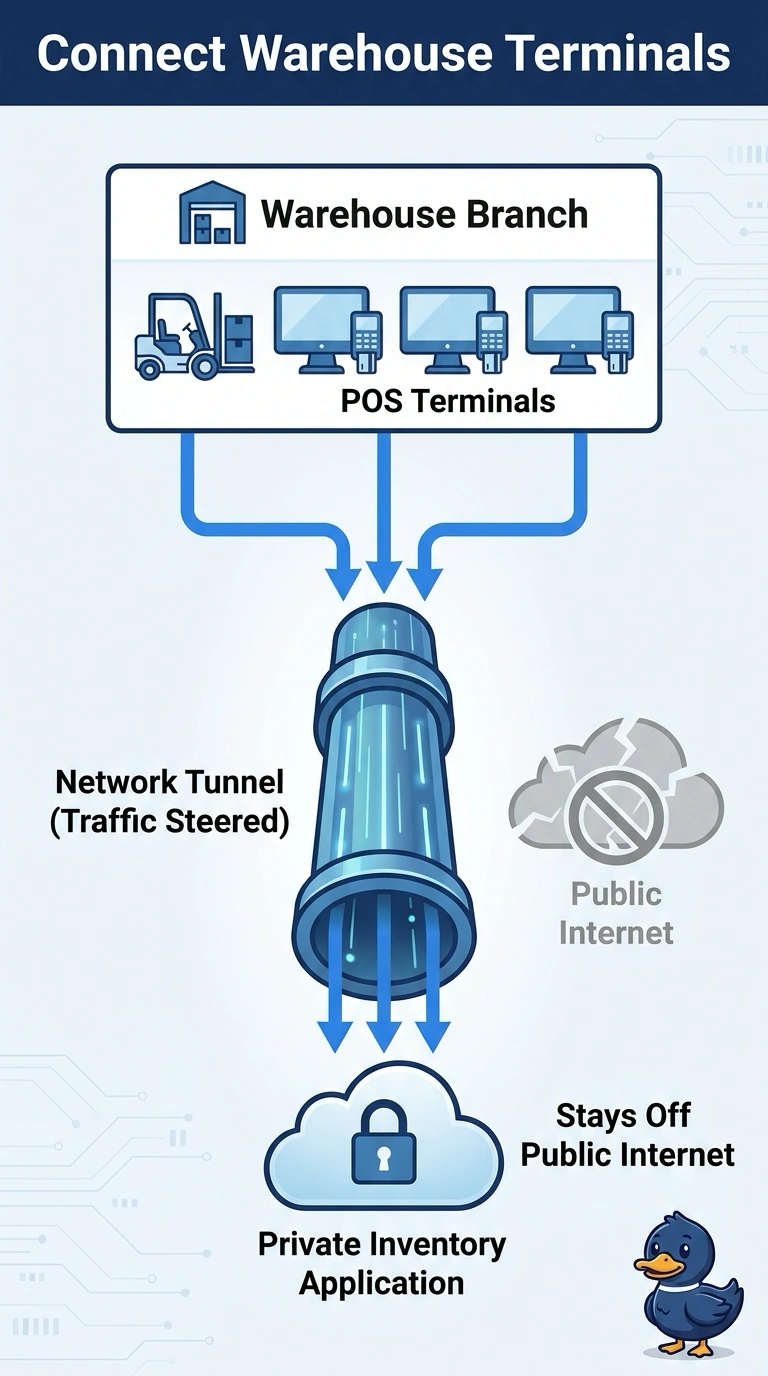
The loading dock serves every register in the store, while one manager's car does not. You steer the warehouse branch through a network tunnel so the point-of-sale terminals reach the private inventory application. A client on a single laptop, or a public address, does not cover those terminals.
Full Explanation
For these non-web terminals without a user client, use the branch tunnel. The point-of-sale terminals cannot run Cisco Secure Client, so a network tunnel from the warehouse is what carries them to the private inventory application without putting that application on the public internet. Installing Cisco Secure Client on the shift manager laptop covers only that laptop. Sharing one user session does not attach the terminals to the application. Publishing the inventory application on a public address and opening its port exposes a private system and abandons the private-access design. A browser bookmark for clientless access fails because clientless zero-trust access is a browser path for HTTP and HTTPS, and this inventory client is not a web application. Exam caveat: a network tunnel group uses IPsec with IKEv2 and needs routing, so the tunnel being the right design still depends on the private prefixes being reachable through it. Operational check: from a terminal that has no Secure Client installed, open the inventory application and confirm the session arrives through the branch tunnel rather than through a public address.