
A utility's primary-region network tunnel to Cisco Secure Access is down, and the secondary-region tunnel is up. Where should this utility send its private traffic?
Select an answer to reveal the explanation.
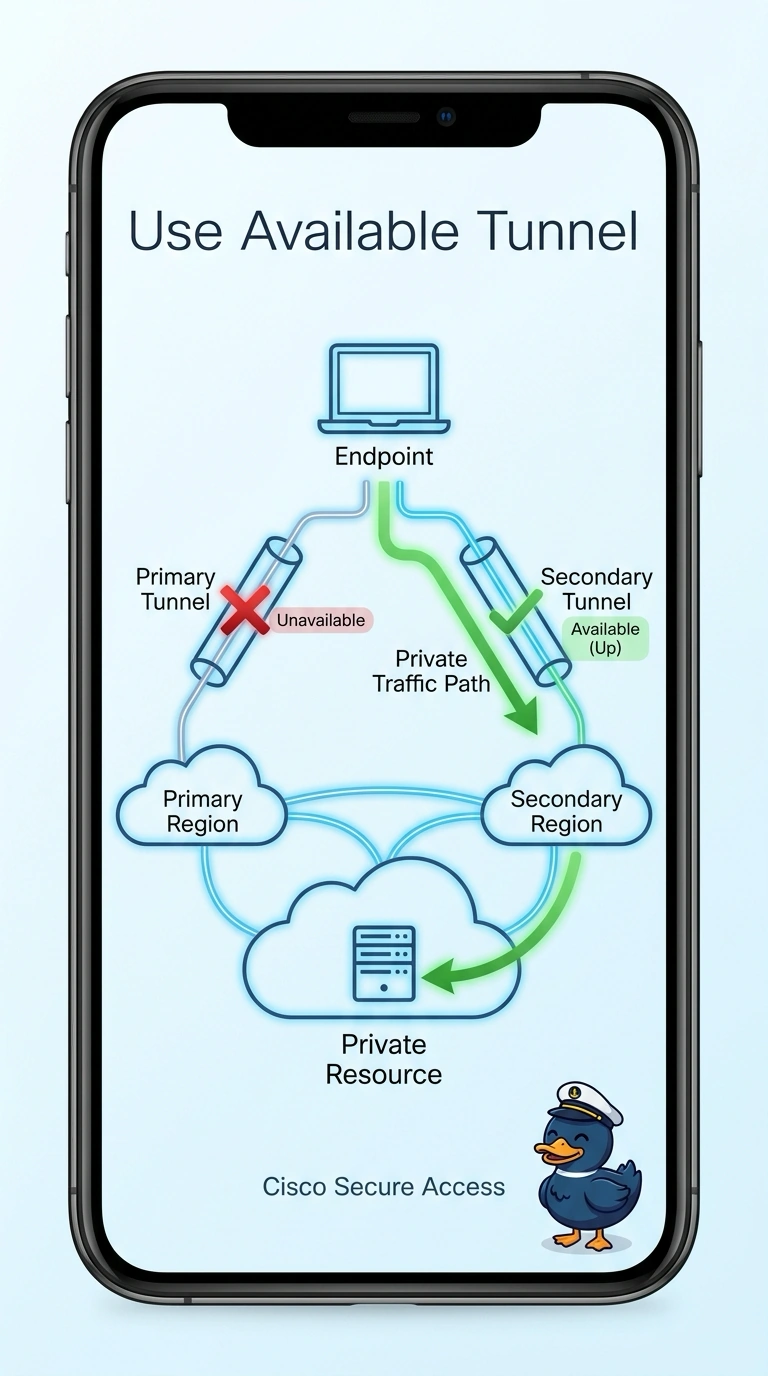
Short Explanation
When the main ferry is tied up and the backup ferry is running, the cars board the backup. You send private traffic across the secondary-region tunnel that is up. The trap is keeping the flow aimed at the down primary tunnel, or breaking straight out to the internet.
Full Explanation
Private traffic that was using the primary-region network tunnel needs a live path, and the secondary-region tunnel is that path. Send it across the secondary-region tunnel that is up, so private traffic uses the region path that is available. Keep sending private traffic at the down primary-region tunnel until that region is fully restored and the users stay on a path that is down. Out a direct internet breakout that leaves Secure Access, on the claim that a down primary region ends private access, drops the private applications out of the edge entirely. A down primary region does not end private access when the secondary tunnel is up. Onto new public addresses on the private applications, so neither region tunnel is required for this utility, publishes private apps just because one region tunnel failed. Exam caveat: region resilience for a network tunnel is the other region's tunnel, not a public address and not a direct breakout. Operational check: verify the secondary-region tunnel is established and that the private routes point at it while the primary tunnel is down.