
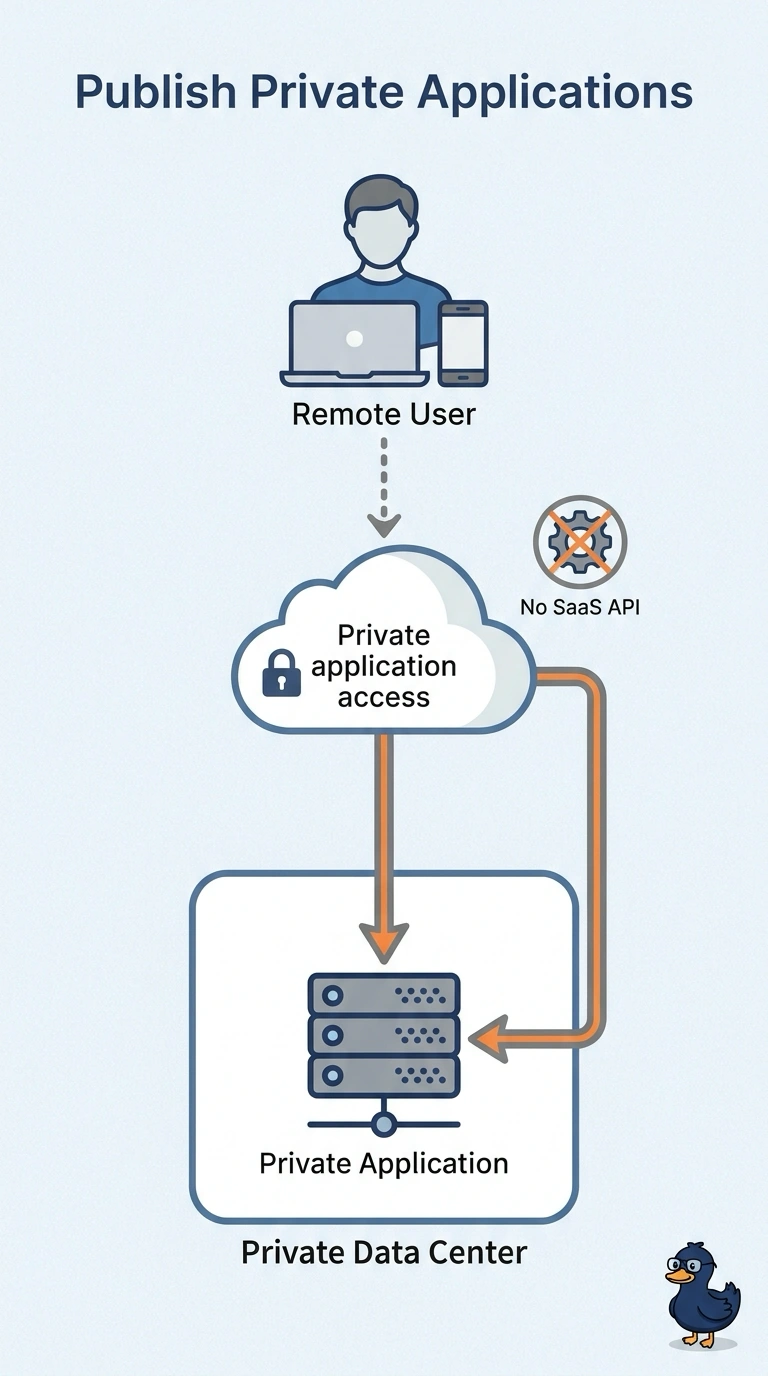
A factory keeps an application in its private data center, the application has no SaaS API, and the team still wants remote users to reach it. Which control publishes that private application?
Select an answer to reveal the explanation.
Short Explanation
A mall directory lists stores, and it will not publish a private road that is not a store. You publish this data-center application with private application access because it has no SaaS API. The trap is asking a broker to invent that API, adding a guardrail, or blocking the name in DNS.
Full Explanation
A cloud access security broker discovers shadow applications and applies controls to sanctioned SaaS tenants. It does not publish a private application that has no SaaS API. Private application access is the control that exposes a named private application to an authorized user without placing that user on the whole network. Publishing the data-center application that way matches an application that lives only in the factory. Asking the cloud access security broker to publish it through a SaaS API the application does not have waits on an interface that will never exist. Adding a generative-AI guardrail inspects prompts on an AI application. The data-center system in this scenario is not that kind of application, and a guardrail does not publish it. Blocking the application's internal name at the corporate DNS resolver hides the name from people who use that resolver. A block is the opposite of publication. Exam caveat: clientless private access is the browser path for HTTP and HTTPS, while client-based private access covers a broader set of application protocols. Pick the form the application actually speaks. Operational check: publish the application by name, connect as an authorized remote user, and confirm the session reaches that application without a route to the rest of the data center.