
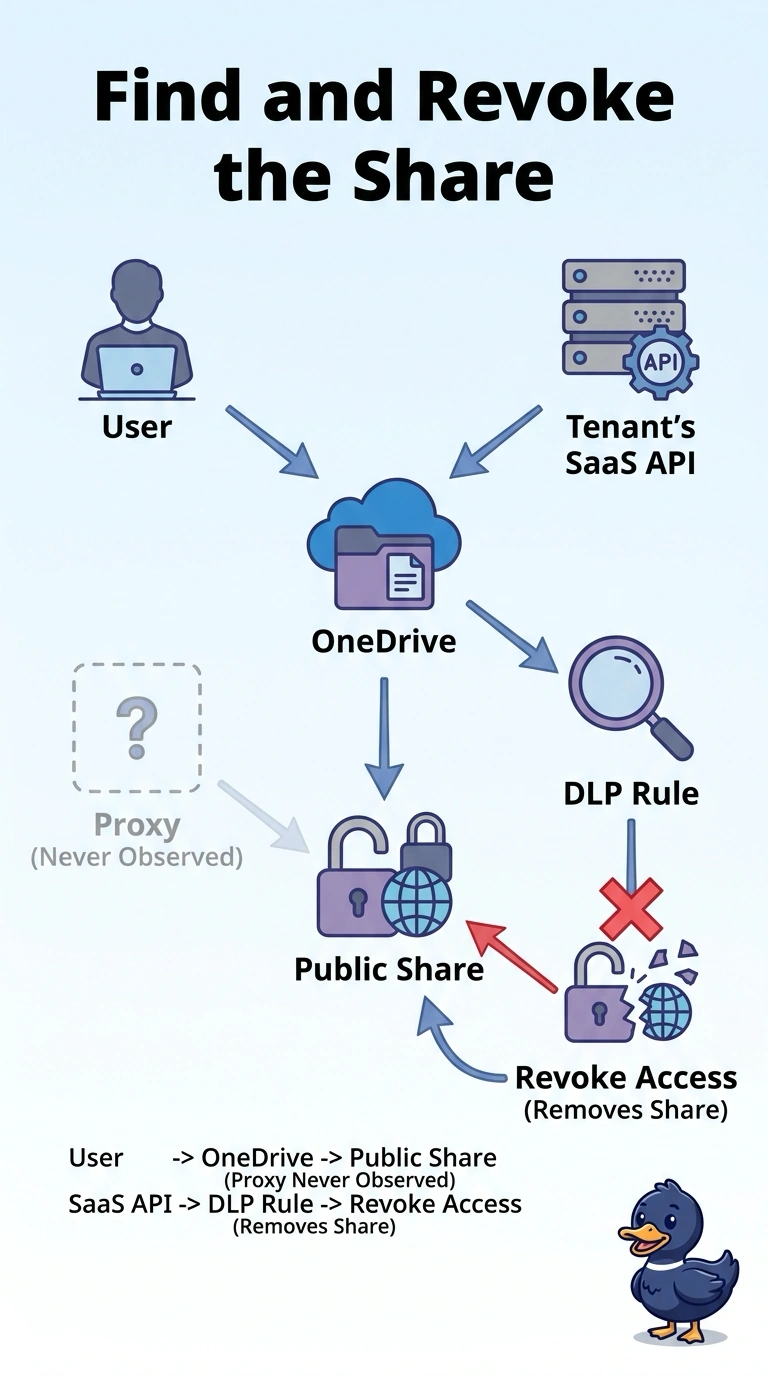
An airline employee creates a public link inside the sanctioned, authorized OneDrive tenant from a home computer that never used the corporate proxy, so the inline session was not observed. The file matches a SaaS API DLP classification and exposure rule. Which control can still find and revoke that share?
Select an answer to reveal the explanation.
Short Explanation
A locksmith can change the storeroom lock even if nobody watched the person who propped the door. You use the tenant's SaaS API DLP rule with Revoke Access to remove the public share the proxy never saw. The trap is asking the inline proxy to undo a session it never observed.
Full Explanation
Inline controls need the session. This public link was created from a computer that bypassed the proxy, so the proxy never observed it and cannot be the tool that revokes it. A SaaS API DLP rule on the authorized tenant detects files that match its classification and exposure criteria, and Revoke Access can remove the public share even when the link was created off-network. Revoke Access has additional share and ownership effects, so it is not link-only remediation. That is the control that still works after the session was missed. A clientless zero-trust bookmark gives browser access to a private HTTP application. It does not reach into a sanctioned SaaS tenant and delete public links. DNS security on the corporate resolver can block a later lookup that uses that resolver. It does not remove a share that was created without a lookup through it. The inline proxy policy has no session to judge and no share object to revoke. Exam caveat: API controls cover data at rest in the tenant, including changes made off-network. Inline policy does not reconstruct a session it never saw. Operational check: create a public link from an unmanaged test client, confirm the proxy log has no session, and confirm the tenant's SaaS API DLP rule detects the exposed file and applies Revoke Access.