
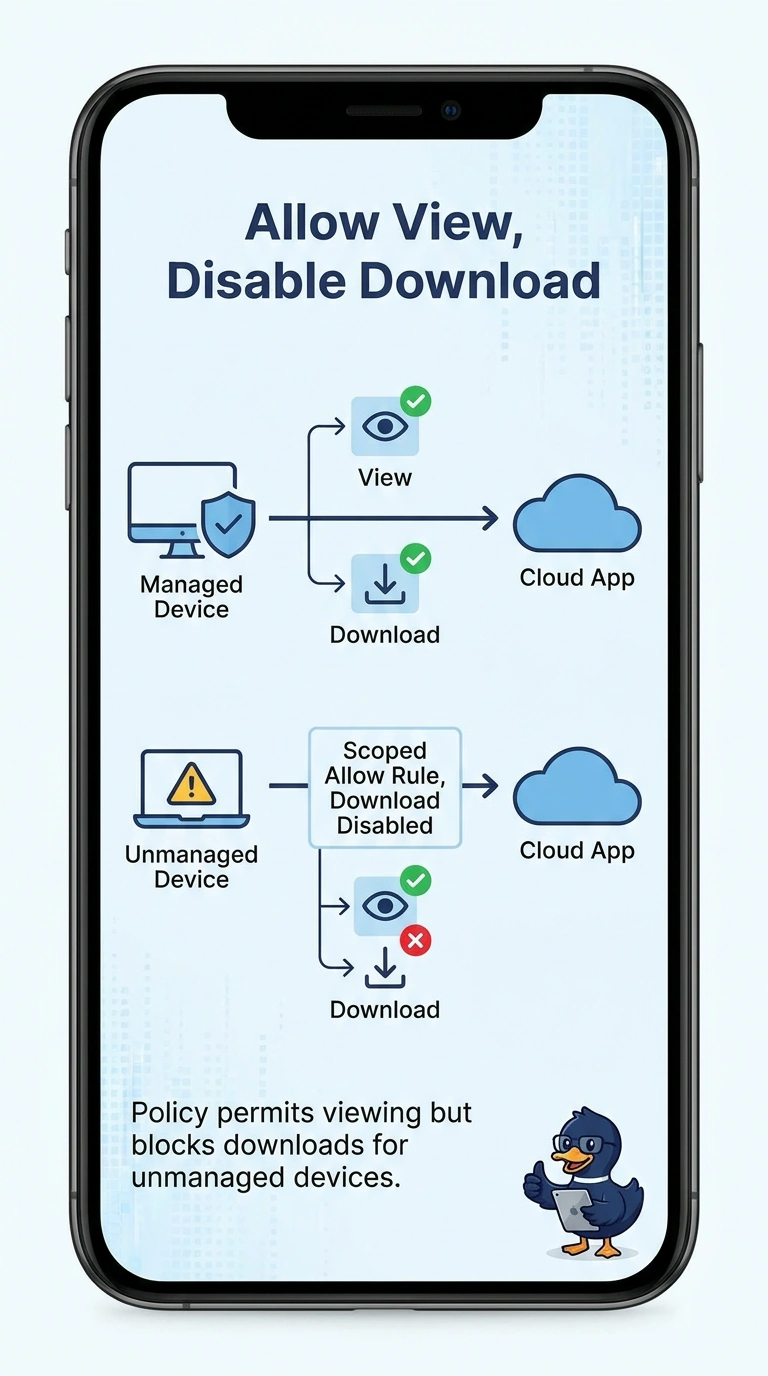
A bank will let unmanaged devices view a sanctioned financial application, but those devices must not download files from it. The inspected app supports Advanced Application Controls for download, and the gateway can distinguish the unmanaged traffic under the scoped rule. Which control enforces that split?
Select an answer to reveal the explanation.
Short Explanation
A reading room can let you look at a book and still stop you from walking out with it. You use an allow rule for that scope with download disabled, so the view stays open. The trap is blocking the whole application, its name, or a malware hash, any of which misses that split.
Full Explanation
Secure Access internet rules can apply Advanced Application Controls to a supported, inspected application, so an allow rule scoped to the unmanaged devices can disable download while the view stays open. That is the bank's stated split, and it depends on the gateway being able to distinguish that unmanaged traffic under the scoped rule. Blocking the sanctioned application for every device removes the download and also removes the allowed view, including for devices that were supposed to keep reading. Blocking the application's DNS name for unmanaged devices is a coarse name control. It stops resolution, so both the view and the download fail together, and it does not distinguish the activity. Quarantining a malware hash looks for a known file verdict the scenario never supplied. Download restriction here is an activity decision, not a malware disposition. Exam caveat: the control only fires when the session reaches the gateway, so a device that bypasses the proxy never receives the download restriction. Operational check: sign in from an unmanaged test device, confirm the sanctioned app still renders, and confirm a download attempt is denied while a managed device outside that scope can still download.