
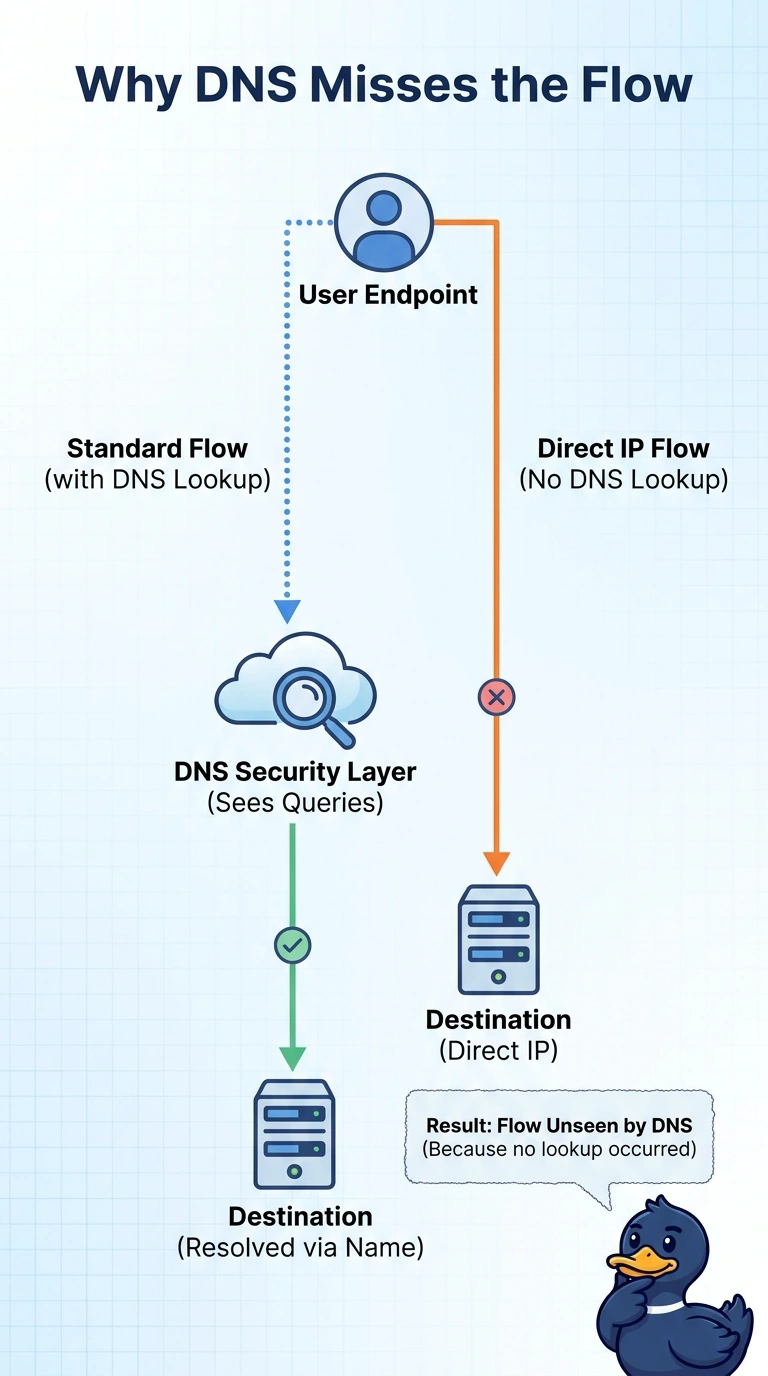
A factory controller reaches a malicious host by a hardcoded address and does not perform a name lookup. Why does the DNS security policy miss that flow?
Select an answer to reveal the explanation.
Short Explanation
Think of a driver who already knows the street number and never asks for directions. You miss this flow because no name lookup occurs, so DNS security has no query to judge. The trap is blaming a web category, or claiming the resolver blocked a name the controller did not ask about.
Full Explanation
DNS security evaluates lookups. A flow that uses a hardcoded address and does not ask DNS is invisible to that policy, and the gap is the missing lookup rather than a wrong web category. No name lookup occurs, so DNS security does not see a query it can allow or block for this flow. Saying the industrial web category is set to allow, which is why this address was skipped by DNS security, invents a category decision the resolver did not make. Saying the protected resolver blocked the name, and the controller overrode that block with a category exception, also assumes a lookup that never happened. DNS security did not read the file body at that address, and it did not mark the body clean for the controller, because a resolver does not inspect a file body. Exam caveat: a hardcoded address, a hosts-file pin, and an unmanaged resolver are separate ways to skip the protected path. Operational check: capture the controller's traffic and confirm there is no DNS query before the connection, then block the address with a control that does not depend on a lookup.