
A university content-delivery name is shared by the wanted learning application and an unwanted page that differs only by URL path. Which control stops the unwanted page without breaking the learning application?
Select an answer to reveal the explanation.
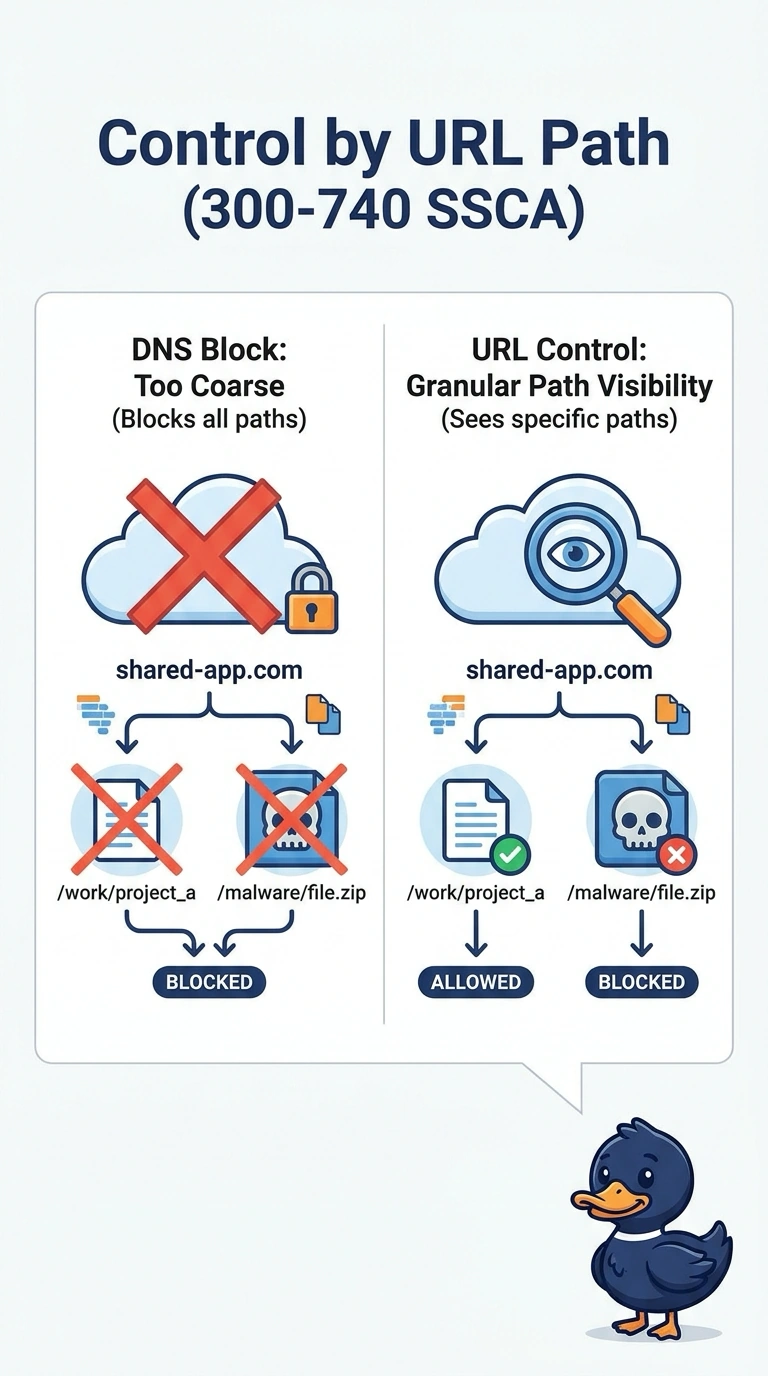
Short Explanation
Think of one street name that covers two houses, and a rule that bans the whole street. You use a URL control that can see the path, because a DNS block of this shared name is too coarse and would break the learning application too. The trap is blocking the parent name, or every education site, and expecting the wanted application to survive.
Full Explanation
DNS security is a coarse control on a name that many sites can share, and it does not show a URL path. A URL control that can see the URL path stops the unwanted page while the learning application on the same content-delivery name keeps working. A DNS block of the whole content-delivery name does not leave the learning application resolving normally, because both pages share that name. A file-body inspection at the resolver is not something DNS performs, so it cannot block only the unwanted page and keep the learning app. A category block of every education site is broader than one path, and it is not the finer control for one path on a shared name. The gateway rule can name the unwanted path and leave the learning application path alone, which is a split that a single content-delivery name cannot express. Exam caveat: when the wanted application and the unwanted page share a name, move the decision to a control that sees the path. Operational check: test the learning application URL and the unwanted path separately, and confirm only the unwanted path is denied.