
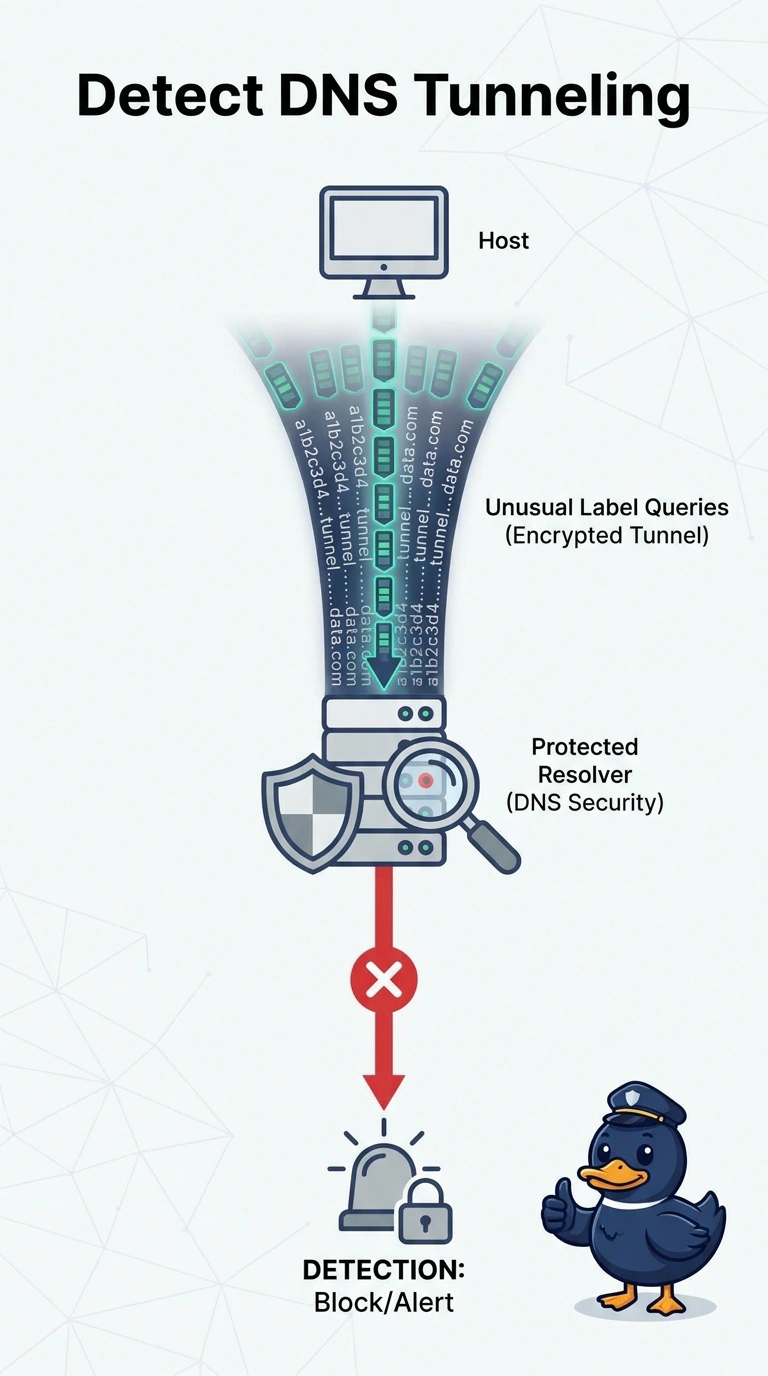
A hospital workstation is sending a high volume of unusual DNS label queries that encode a tunnel, and the pattern is visible at the protected resolver. Which control is in a position to detect that behavior?
Select an answer to reveal the explanation.
Short Explanation
You catch a coded note by watching strange envelopes, not by searching a cabinet that never received them. Unusual DNS label queries that carry a tunnel show up at DNS security on the resolver. A file data-loss rule does not see that query stream.
Full Explanation
DNS security sees queries that arrive at the protected resolver, including a high volume of unusual labels used as a tunnel. That query behavior is visible before any file exists for another tool to scan. Using DNS security at the protected resolver detects the unusual label queries that are carrying the tunnel. Writing a file data-loss prevention rule and expecting it to see the tunneled payload inside those unusual DNS queries points a file-content control at a DNS query stream it does not inspect. Blocking a file-sharing web category, and treating that category block as coverage for the DNS tunnel, points a web rule at label queries that category never inspects. Encrypting the workstation disk protects stored bytes and does not make the tunneled queries become visible in any new way, because the pattern is already at the resolver and disk encryption is not a DNS detector. On the exam, a DNS tunnel made of odd labels is a DNS-security observation, and file data-loss prevention does not see that stream. In operations, review the resolver log for this workstation's unusual labels and confirm DNS security is what flagged them, rather than a file rule.