
A provider is deploying twelve ISE VMs across three regions in one weekend window, and the team has banned per-node console setup so nobody is answering setup prompts at 3 a.m. Every node must also land in the existing deployment and be governed by the primary admin node. Which provisioning approach satisfies both the unattended first boot and the single-deployment requirement?
Select an answer to reveal the explanation.
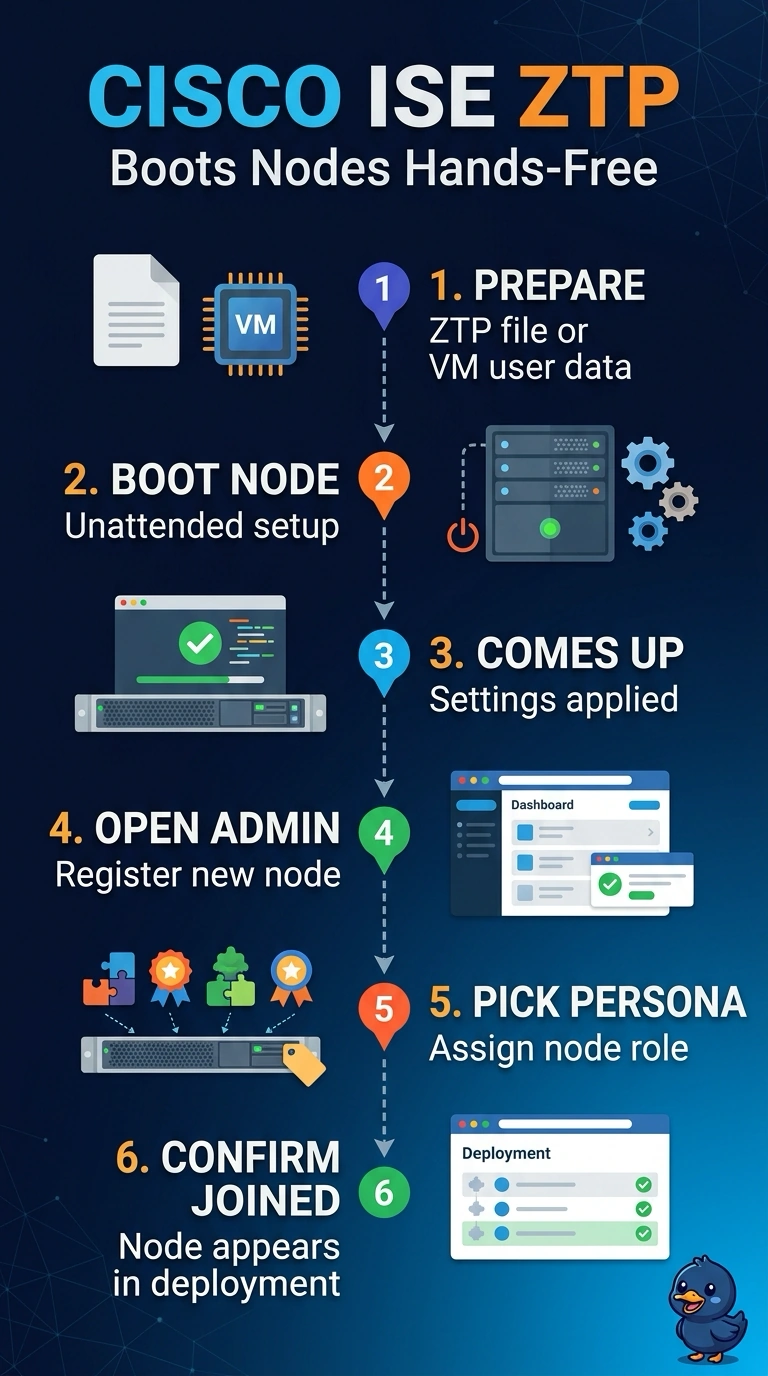
Short Explanation
A ZTP configuration image is like a packed setup checklist, so you can boot each VM without answering prompts. Then you’ll register every node as a secondary from the primary admin node, joining them to the existing deployment under its control.
Full Explanation
The correct approach addresses both constraints: a ZTP configuration image supplies the information needed for unattended first boot, and registering each node from the existing primary admin node brings it into the current deployment under that deployment’s administration. Using ZTP images and creating a new deployment with its own primary admin node automates installation, but does not put the nodes in the existing deployment. Completing standard interactive setup and registering nodes as secondaries from the existing primary admin node is a supported, familiar way to add nodes to that deployment, but someone must answer first-boot prompts, violating the ban on per-node console setup. Using ZTP images and creating three regional deployments also automates first boot; regional deployments can be reasonable when independent administration or separation is intended. However, they are not the single existing deployment governed by its primary admin node. Exam caveat: “unattended” describes how a node is initially provisioned; it does not by itself establish deployment membership, node role, or administrative authority. Practical check: before starting the rollout, validate a ZTP image on a representative VM, confirm its network and registration settings, and verify that the primary admin node can discover and register it in the intended deployment.