
A regional insurer's access ports serve VoIP phones with no supplicant alongside laptops that must complete 802.1X before any fallback. The phones wait out the full 802.1X failure window before MAB puts them on the voice VLAN, while ISE must still make the authorization call. Which switchport setting change shortens this MAB fallback?
Select an answer to reveal the explanation.
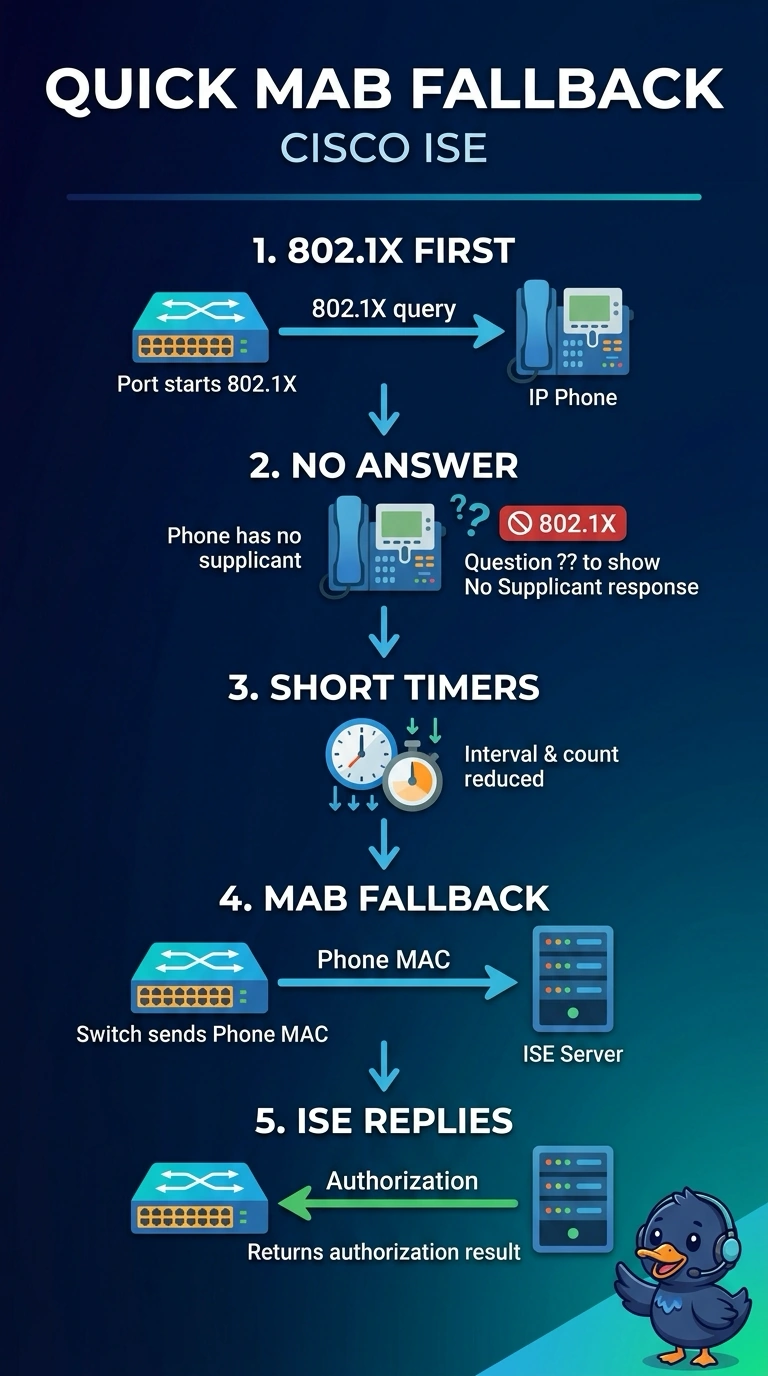
Short Explanation
Your switch is like a door checking for an 802.1X badge before trying MAB: shorten the EAPOL request interval and reduce the maximum request count so a phone without a supplicant reaches MAB sooner. ISE still makes the authorization decision, and laptops still get their 802.1X chance before fallback.
Full Explanation
The correct adjustment reduces the time the switch spends sending EAPOL requests to a phone with no supplicant before starting MAB. Lowering the request interval and maximum request count preserves the required 802.1X-first sequence, then allows MAB to trigger sooner; the resulting authorization can still be sent to ISE. Reducing the MAB RADIUS timeout or retry count can help when ISE is slow to respond after MAB begins, but it does not shorten the preceding 802.1X failure window that causes the stated delay. A voice-domain critical VLAN is a common resilience measure for RADIUS outages, but it provides local fallback authorization rather than ensuring an ISE authorization call in that condition, and it does not speed ordinary MAB fallback. Multi-domain authentication is appropriate for a phone and laptop sharing a port, but it governs how the two device roles are accommodated; it does not change how long the switch waits for 802.1X before trying MAB. Exam caveat: timer names and behavior vary by switch platform and software release, so confirm the exact EAPOL and retry settings rather than assuming similarly named RADIUS timers control this phase. Practical check: compare port authentication timestamps and ISE logs before and after the change, confirming earlier MAB initiation, an ISE authorization request, and the intended voice VLAN assignment.