
In a warehouse, label printers and handheld scanners both land in the generic endpoint profile, so the printer-only authorization rule stays untested. The scanners must stay out of the printer profile. Only DHCP and SNMP data reach ISE for these label printers, with HTTP and DNS data absent. Which profiling policy change gives the printer profile enough certainty to win?
Select an answer to reveal the explanation.
Short Explanation
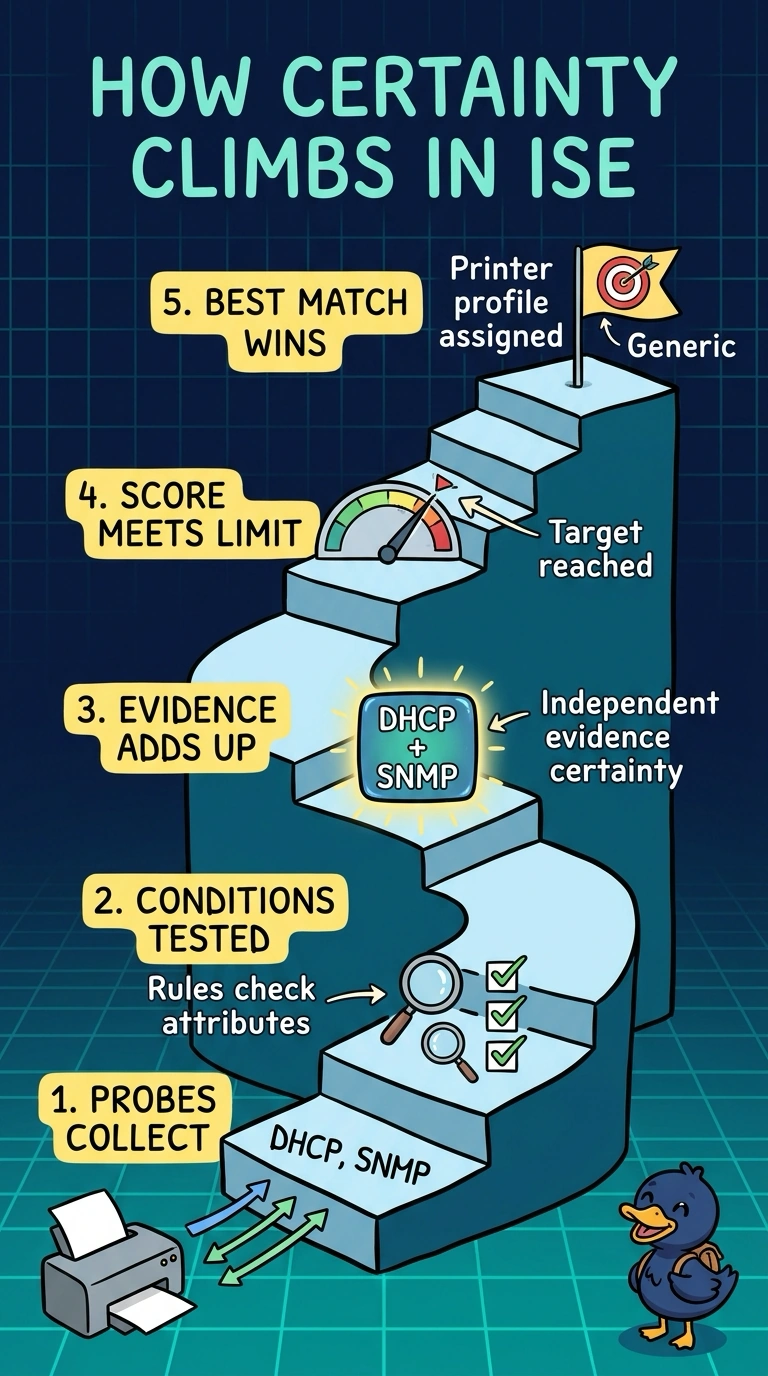
You've got it: certainty only climbs when independent evidence agrees, and HTTP data simply never arrives from these printers. Two strangers confirming the same story carry far more weight than one person rereading the same page. SNMP gives you that second, unrelated voice.
Full Explanation
The correct change uses SNMP polling to obtain device attributes from the printers and applies printer-specific conditions in ISE. That adds evidence capable of distinguishing printer devices from the generic endpoint match, allowing the printer profile to win without relying on HTTP or DNS telemetry. The DHCP-only approach is a familiar way to refine profiling with vendor class, requested options, and hostnames, but raising its certainty does not make shared or variable DHCP signatures printer-specific; it can still admit scanners, contrary to the explicit separation requirement. Combining SNMP sysObjectID with DHCP vendor data is also a common correlation technique, but those attributes may identify a manufacturer rather than the device role. A manufacturer-level match therefore does not establish that the endpoint is a label printer rather than another device from the same vendor. A maintained MAC allowlist can separate known printers from scanners, but it assigns the profile from inventory identity rather than improving ISE's profiling evidence or certainty, so it does not meet the requested profiling-policy change. Exam caveat: a technically specific attribute is useful only if it is actually exposed by the device and collected in the ISE profiling flow; vendor identifiers alone often describe a product family. Practical check: inspect live endpoint attributes and the profile's matching and certainty details for representative printers and scanners, then confirm that only the printers satisfy the printer-specific conditions.