
A campus network engineer is tuning the ISE profiler for a lab subnet holding 40 laser printers and 300 workstations. The printers send only plain address requests, nobody browses to them, and their SNMP community is unknown, but they do accept TCP connections on ports 9100 and 515. Which probe should the engineer enable so the printers match a profile?
Select an answer to reveal the explanation.
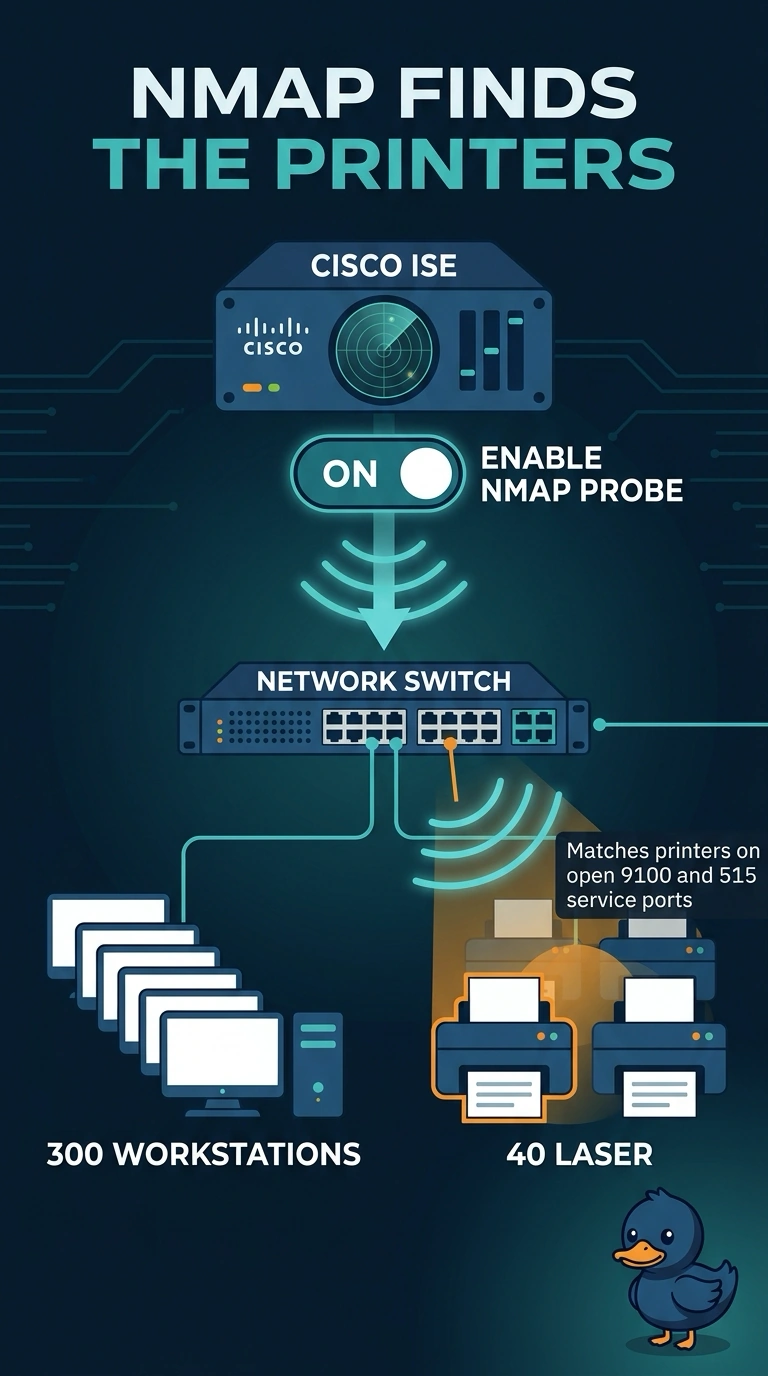
Short Explanation
Your printers only reveal themselves through open service ports, so the NMAP probe is the one that can see them. It scans the host, records 9100 and 515, and turns the hits into profiling evidence. The other probes depend on data these printers do not provide in this scenario.
Full Explanation
The NMAP probe is the best fit because the printers accept TCP connections on ports 9100 and 515, giving the profiler observable service-port evidence for matching them to a printer profile. This approach does not depend on users generating web traffic or on the engineer already knowing SNMP credentials. A DHCP probe can use option 55, the parameter-request list, as a device fingerprint, but the scenario establishes only that these printers send plain address requests; it does not establish that their option lists are present or distinctive enough to identify them. An HTTP probe can classify devices from responses served by embedded management pages, but it needs HTTP traffic to observe, and nobody browses to these printers. An SNMP probe can use system-description data for profiling, but querying it requires reachable SNMP service and valid read credentials; the community is unknown. Exam caveat: an open port is evidence for classification, not proof of device identity, so profiles should combine reliable attributes where available. Practical check: verify that the NMAP probe is enabled and that the ISE profiler can observe the printers’ network path and detect ports 9100 or 515.