
A city health centre sees 150 visitors every day. Each visitor must complete registration themselves at the captive portal using their own name and email, receive internet access straight away, and have the account expire the same evening. Which ISE guest access type fits this visitor journey?
Select an answer to reveal the explanation.
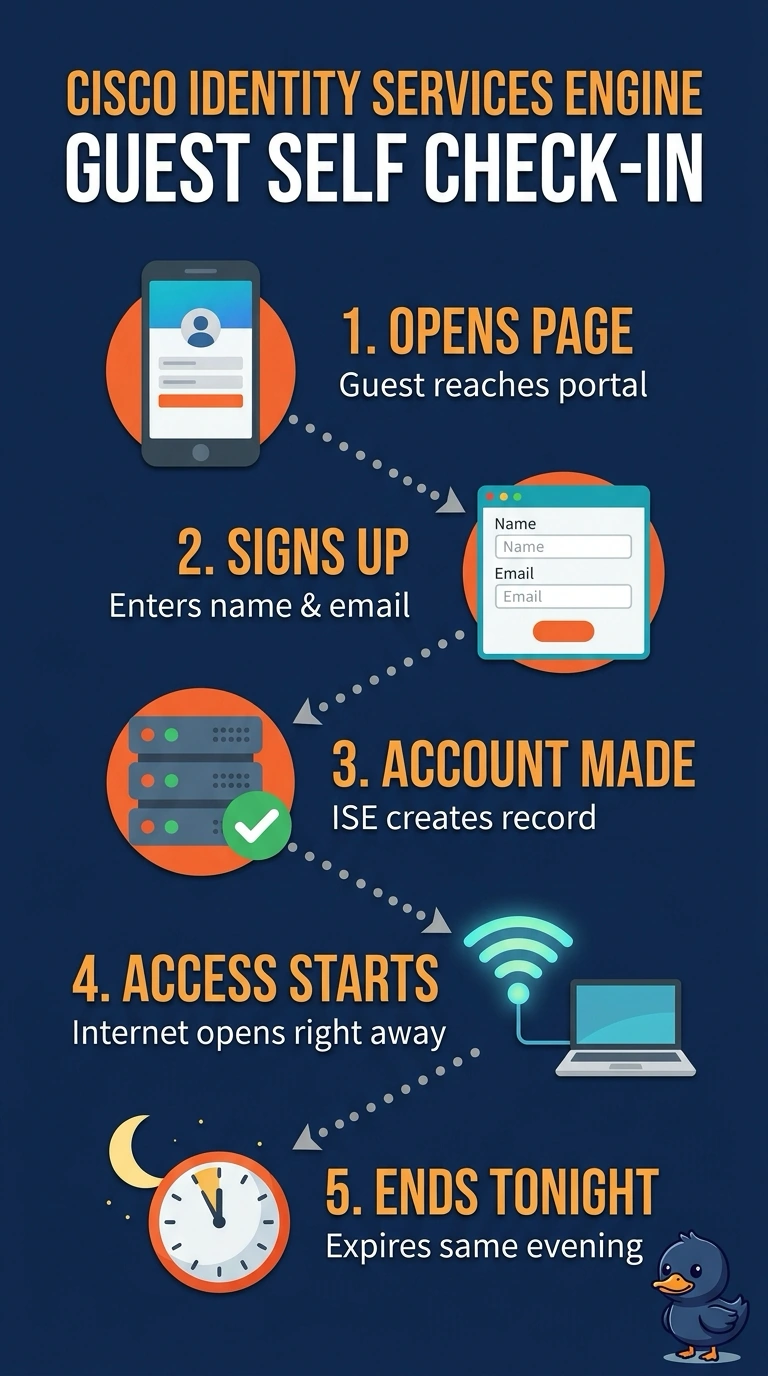
Short Explanation
You're looking for a flow where the visitor builds the account at the portal and access starts without waiting. That's the self-registered guest type, like a self-service kiosk where filling in the form opens the door. Sponsor approval and a 24-hour lifetime each break one of your requirements.
Full Explanation
The self-registered guest account is the best fit because each visitor enters their own name and email at the portal, can receive access immediately, and can be assigned an expiration time that evening. This directly matches all three important parts of the journey: who completes registration, when access begins, and how long the account remains valid. A self-registration workflow with sponsor approval is a legitimate way to add oversight, but it does not provide immediate access: the visitor must wait for the sponsor to approve the request. A self-registered account with a 24-hour lifetime preserves visitor-entered details and immediate activation, but the account remains usable beyond the required same-evening cutoff. A reception-created individual account can provide each visitor with separate credentials, immediate access, and an evening expiration; however, staff rather than the visitor complete account creation, so it misses the self-registration requirement. Exam caveat: ISE guest access types and portal settings are related but distinct; the selected workflow must be configured to allow immediate activation and the required expiration, rather than assuming those behaviors from the account type alone. Practical check: test the configured portal with a visitor account and confirm that the visitor enters their own details, gains access without approval, and loses access at the intended evening expiration.