
A logistics company has a data center and three warehouses on VPN links that can drop for ten minutes during storms. Warehouse authentication uses ISE internal users and must keep working during an outage, policy must be authored in one place, and this year's budget allows exactly four ISE nodes. Which ISE deployment design meets all three constraints?
Select an answer to reveal the explanation.
Short Explanation
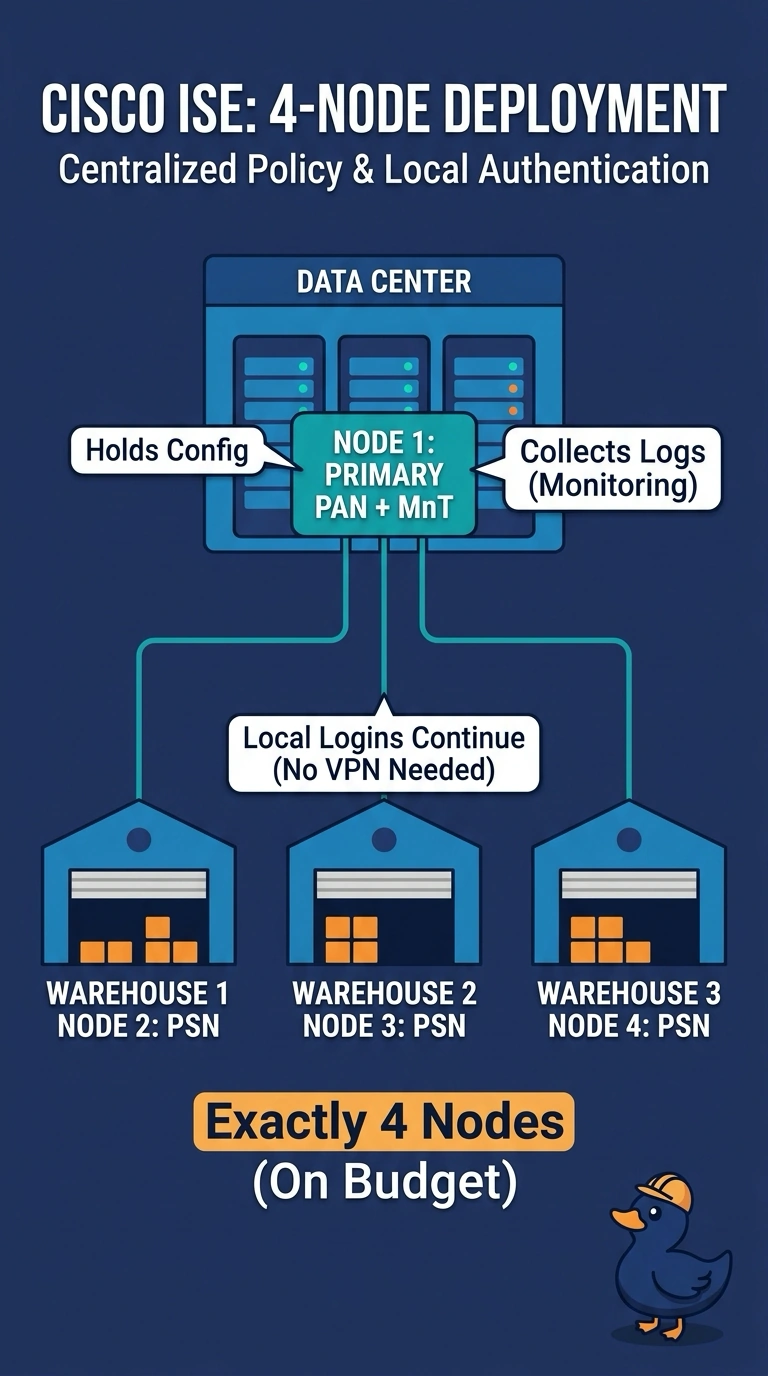
Keep the policy administration node in the data center so you can author policy in one place, and place one policy service node at each warehouse. Your internal-user settings replicate to those nodes, letting staff authenticate during a VPN outage—like having a local counter at each warehouse connected to one head office.
Full Explanation
The design with a combined primary policy administration and monitoring node in the data center and one policy service node at each warehouse meets all three constraints. You author policy centrally, and each warehouse can authenticate against ISE’s internal-user store through its local service node when the VPN is unavailable. The combined central personas and three warehouse service nodes use exactly four nodes. A design with service nodes at only two warehouses and a central service node still centralizes policy, but users at the unserved warehouse must reach a remote node, so a VPN outage there interrupts authentication. A design that uses Active Directory for authentication also provides local service nodes and centralized policy, but changes the required authentication source from ISE internal users. Separating the administration and monitoring personas while retaining a service node at every warehouse provides the requested authentication behavior, but requires five nodes, exceeding the budget. Exam caveat: a local policy service node alone does not guarantee outage authentication; the required user records and applicable policy must be available to it. Practical check: verify node roles and count in the deployment plan, then test internal-user authentication at each warehouse with its VPN link disconnected.